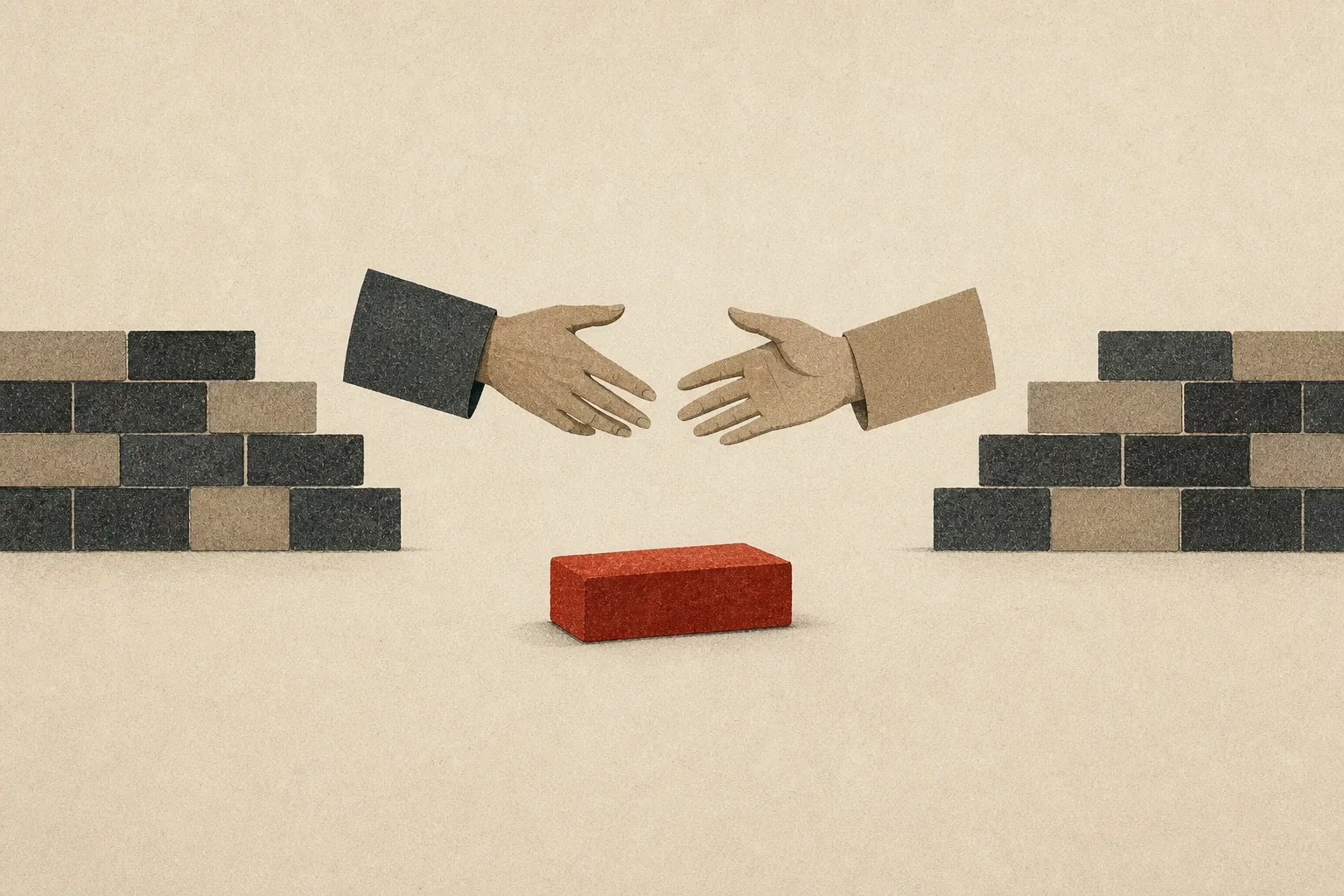
The event that sets Good Will Hunting in motion is not a theorem. It is a man Will Hunting remembers from kindergarten.
Will sees Carmine Scarpaglia through the window of a car. Carmine used to beat him up when they were children. Will stops the car, crosses the street and attacks him. Chuckie, Morgan and Billy pile in. The police arrive. Will is arrested. The arrest puts him before a judge; the judge puts him within reach of Gerald Lambeau; Lambeau puts him in therapy. The most famous mathematical prodigy in cinema is rescued only because he cannot drive past a childhood injury without reopening it.
That is usually treated as character establishment. Will is brilliant, working-class, loyal and violent. Now the story can begin.
But the fight is the story.
An adult body has returned to the scene of a child's helplessness, and this time the child has brought friends. Carmine once proved that Will was alone. Chuckie and the others now prove that he is not. They do it in the only currency Will completely trusts: they incur danger beside him.
Later, when Lambeau calls these friends gorillas, Sean explains their value. If Will asked, any one of them would take a bat to Lambeau's head. “That's called loyalty.” Elsewhere, Sean asks whether Will has a soul mate. Will names Chuckie. Sean answers that Chuckie is family; he would lie down in traffic for him.
There is the film's moral machinery, stated twice and almost always remembered as colourful dialogue. Will is an orphan. The adults meant to protect him were absent or abusive. Promises have no evidentiary value. Danger does.1
A person who enters danger for you has paid for the signal.
The evidence he accepts
Economists got there first, with a phrase too ugly for the thing it names.
If a declaration is cheap, both the faithful and the faithless can make it. “I love you” costs a liar the same three words it costs a person who means them. A signal becomes informative when it is substantially cheaper, more valuable or more tolerable for one kind of person to produce than another. The peacock has a tail. The applicant gets the degree. The friend crosses the street when the police are coming.
Nor is it just a theory about animals and job markets. People read costly pro-relationship acts — surrendered time, money, opportunities — as stronger signs of commitment, in friendship as well as romance. Friendship has a commitment problem too. We cannot see loyalty directly, so we look for things a disloyal person would be unwilling to pay.2
Will has constructed an entire social world out of unusually expensive evidence. Chuckie has years invested. The boys have fights, arrests, construction sites, hangovers and the daily arrival of the same battered car. Their lives function as mutual collateral. Nobody has to say what anybody feels because every day supplies another sunk cost.
Skylar arrives with a different currency. She talks.
She tells Will things. She asks him things. She offers California. She says she loves him. Skylar expects each statement to count as evidence. Will treats words as exactly what an abandoning adult could counterfeit.
So he raises the price.
First he gives her the charming invention: twelve brothers, a large noisy family, a childhood thick with belonging. When she discovers the lie, he supplies the truth: he is an orphan, he was placed in foster homes, he was abused. She stays. Then comes the maximum test. She says she loves him — twice, over his protests — and even writes the exit for him: say you do not love me, she tells him, and I will leave and never call. He says it. And he leaves.
It looks like panic because it is panic. It is also a test.
Will is not waiting to see whether Skylar abandons him. He is changing the conditions until abandonment becomes likely. If she leaves after he injures her, the loss arrives as a result he controlled. He has converted “somebody I need may discover I am unlovable” into “somebody naive failed a test I designed”. The first proposition can destroy him. The second lets him win.
Here the film makes its strategy clearest. Attachment and threat have become coupled. The more important somebody becomes, the more severely they must be tested. Strangers get jokes. Professors get contempt. Therapists get research, obscenity and silence. Sean gets his dead wife. Skylar gets the hidden child and then the attack.3
The cruel property of the strategy is that it works until it works too well. A modest cost may distinguish loyalty from indifference. Push hard enough and loyal people leave too. Their departure is then entered as fresh evidence that nobody stays.
Low trust produces a test. The test produces a rupture. The rupture proves that trust was foolish. The next test becomes more expensive.
He has manufactured the abandonment that proves him right.4
Genius as armour
First, set the mathematics aside. It is a MacGuffin: make Will a chess prodigy or a concert violinist and the emotional machinery survives, because the gift's first job is to be large enough that the world will chase it. Lambeau chases it. So do we. And Will lets them — he hands the theorem to everyone who comes close, because a man everyone is busy admiring is a man nobody is looking at.
The standard reading of Good Will Hunting treats intelligence as the good object trapped inside the bad psychology. Will has a gift; trauma prevents him from using it; therapy removes the obstruction; the gift is released.
The film is more interesting than that. Intelligence is part of the obstruction.
Nothing suggests abuse created Will's mathematical gift. It found a remarkable capacity and recruited it. The romance of the tortured prodigy should be left where it belongs.
Competence makes Will difficult to capture. He can defend himself in court, master a field without accepting a teacher, obtain employment without owing gratitude and expose the weakness of anybody claiming authority over him. Intelligence reduces dependence. More importantly, it lets him know other people without permitting them to know him.
The Harvard bar scene is remembered as class revenge: the poor autodidact dismantles the credentialled plagiarist. It is also a fight on Chuckie's behalf. Chuckie has wandered into an intellectual weight class he cannot survive, so Will crosses the room and puts the other man down. At the beginning of the film Will fights with his body. At Harvard he discovers that memory and argument are cleaner weapons.
He uses the same weapon on therapists. Before they can interpret him, he interprets them. He reads their books, detects their vanity, finds their embarrassment, turns their methods into jokes. With Sean he scans the room, reads the painting, infers grief and attacks the dead wife. What looks like extraordinary insight is insight subordinated to escape.
Knowing is safer than being known.
Psychoanalysis has spent a century naming pieces of this; the labels live in the notes. An intolerable passive state is converted into action: the beaten child becomes the adult throwing the first punch. An idea is kept while its emotional force is removed: Will can casually name attachment disorder and fear of abandonment, which proves that having the correct words is not the same as letting them apply. And experience is made to feel like the consequence of one's own power: if the therapist is a fraud, therapy did not fail him; if Skylar is naive, love did not expose him; if the job is corrupt, refusing it is not a loss.5
Sándor Ferenczi had an image for the traumatically precocious child: the “wise baby”, forced by dangerous adults to become the adult in the room. The clinical literature on children pressed into early responsibility describes a different history, and its modern work on forced maturity is more careful: it can produce competence, distress, resilience or some mixture of all three. The image still fits Will. He has become exceptionally good at the capacities that make adults predictable and need unnecessary.6
The tragedy is not that his intelligence is fake. It is that something genuinely magnificent has been assigned the job of border security.
Lambeau sees the magnitude of the gift and therefore believes he sees Will. He does not. He sees the weapon at full resolution and mistakes it for the person holding it.
The boys from Southie
Southie gives this psychology a social world in which it can look like virtue, because it often is.
South Boston is rendered as a place where institutions classify you and friends arrive. Lambeau offers a future, but his recognition creates a claim: the gift belongs to history, mathematics, the nation, perhaps Lambeau himself. Chuckie offers no theory of Will's value. He is simply outside in the car.
In social worlds where formal protection is distrusted, a reputation for retaliation is not merely vanity. It can deter predation. Friendship is partly an alliance about future conflict: who will take your side when taking your side is expensive? Painful shared experience binds a man's sense of who he is to the group that went through it with him, and with that binding comes willingness to act for the group — a pattern that recurs in studies of soldiers, fighters, ritual initiates and fraternities. This does not prove Will starts fights to manufacture attachment. It explains why danger can become a language of attachment once the ordinary language has failed.7
The film's men are fluent in this language. They can fight, drive, work, insult and show up. They can barely say “I need you.” Costly action allows tenderness to move under a masculine alias.
The temptation is to romanticise this. The film's Southie is a moral geography, not neutral ethnography. The real neighbourhood's solidarity was built amid class abandonment and territorial belonging, but also racial exclusion and the violence surrounding Boston's school desegregation. Every coalition has a boundary. The movie is interested in the beauty of loyalty inside the line and mostly silent about the people kept outside it.8
Even inside the line, the code extracts a price. If love is demonstrated through shared danger, leaving danger can resemble betrayal. The same friends who keep Will alive help make the known world emotionally harder to leave. The coalition is his family and his alibi.
Which is why Chuckie, not Sean, is permitted to say what comes next.
What Sean actually does
Sean is usually described as the therapist who sees through Will. This is true, but it makes therapy sound like another feat of intelligence: Sean has the one interpretation clever enough to defeat the genius.
He does not.
Will already knows the interpretation. He can tell Sean about attachment disorder and fear of abandonment in the tone of a man reading ingredients from a packet. The diagnostic fact has no power because information is not what he lacks.
What Sean supplies is a repeated relational event.
The first version is ugly. Will attacks Sean's dead wife and Sean physically threatens him. It is dramatically effective and clinically indefensible. The important thing is not the threat. The important thing is Thursday at four. Sean returns. Will returns. Sean tolerates silence. He reveals himself without making Will responsible for him. He is injured without either pretending not to be injured or converting injury into expulsion.9
Therapeutic alliances need not be rupture-free. When a rupture is recognised and repaired, outcomes tend to be better. For somebody with Will's model of other minds, a relationship that survives conflict without producing a winner is new evidence.10
This is why “It's not your fault” has to be repeated until it becomes almost embarrassing. Sean is telling Will nothing he does not conceptually know. The first repetition is information and Will bats it away. The next is still information. Then the sentence ceases to function as a proposition and becomes something occurring between two people. Sean crosses the room. Will cannot remain the analyst of the statement. He has to receive it.
The scene is not anti-intellectual. It is about the boundary of intellect. A person can possess a perfect description of his defence while the defence uses the description to remain intact.
The empty doorway
Chuckie begins as the purest proof in Will's system. He will enter the fight. He will risk arrest. He will lie down in traffic. Because his loyalty has already passed every expensive test, he can make a demand no professor or therapist could survive making.
If Will is still laying bricks in twenty years, Chuckie says, he will kill him. Will is sitting on a winning lottery ticket and is too frightened to cash it; staying is not loyalty to the boys, because the boys' loyalty consists precisely in wanting him to have what they cannot.
Then Chuckie says the most important thing in the film. The best part of his day is the short walk from his car to Will's door. For ten seconds he can imagine that Will will not answer — that he has gone without a word.
At the end, Chuckie makes the walk. The door is unanswered. The house is empty. He looks in, understands and smiles.
The old code says an unexplained departure is abandonment. Chuckie interprets it as success.
It is the completion of his character, and the movie's moral turn. At first, loyalty means: I will enter danger with you. At the end, it means: I will let you enter a life without me. Chuckie's final sacrifice is not his body but his claim on Will's presence. He gives up access, gratitude, explanation and the right to accompany him. The friend who proved love through violence proves a larger love through relinquishment.11
Will makes the corresponding move. Driving to California is not simply choosing Skylar instead of mathematics. He has no proof Skylar still wants him. He cannot know the relationship will last. He cannot research, intimidate or solve his way to a guarantee. For once, intelligence cannot settle the outcome before he enters it.
The conventional moral of Good Will Hunting is that a brilliant man must stop wasting his talent. The better one is that a traumatised man must stop using talent to make vulnerability unnecessary.
What he learns is not that people are safe. Sean cannot promise that. Skylar cannot promise that. Chuckie, of all people, knows better than to promise it. Will learns that demanding certainty from love destroys the thing being tested.
The title can be heard as the description of Will's whole life. He is hunting for evidence of good will. He has found the only people who would cross the street into a fight for him, and it is not enough, because no price can turn another person into a theorem.12
The movie ends when Will stops asking for proof.