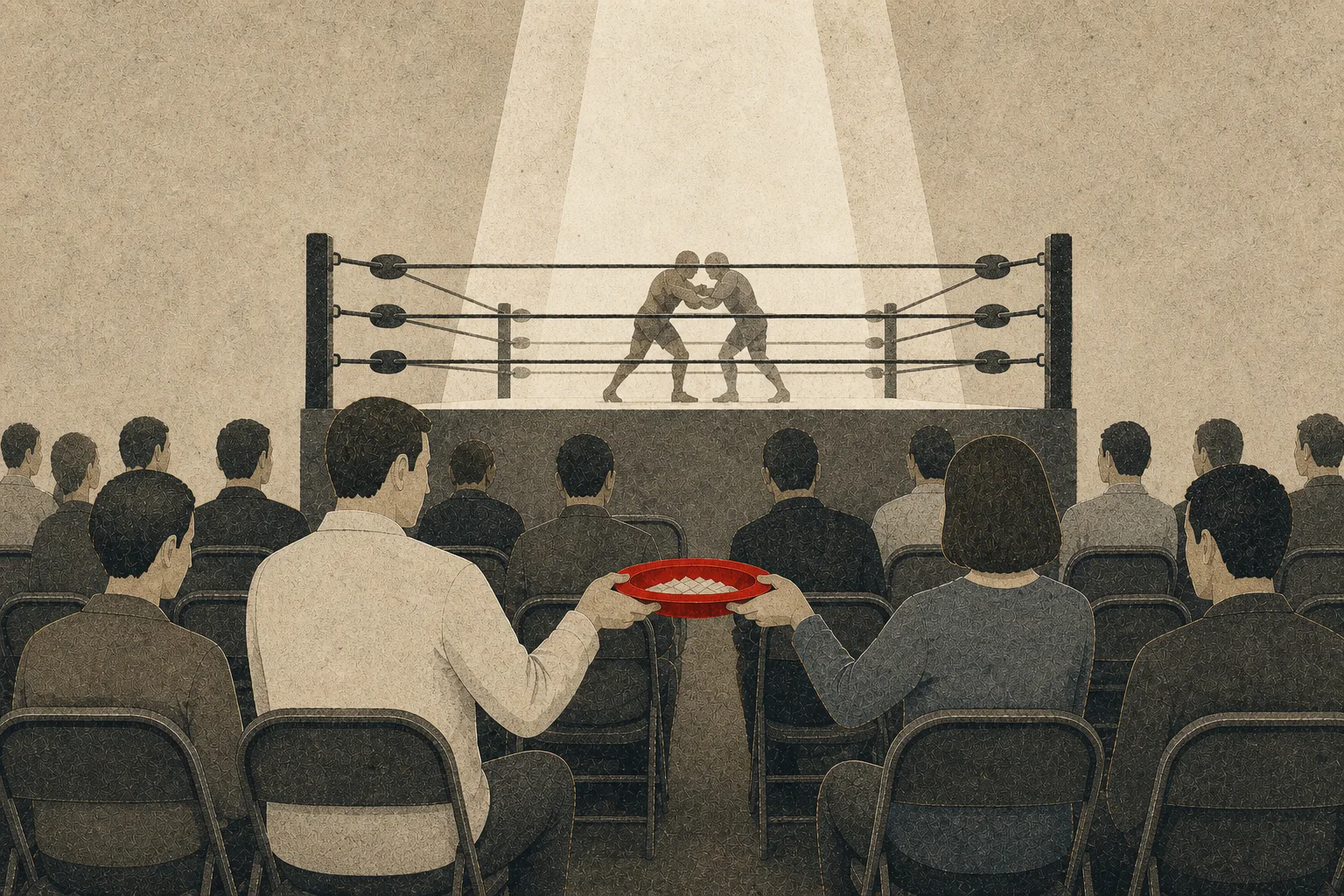
Spokesmen for the World Wrestling Federation told the New Jersey Senate, in Trenton, that professional wrestling is just “entertainment”. They asked the state to write into law that their men struggle “primarily for the purpose of providing entertainment to spectators rather than conducting a bona fide athletic contest”.1 The New York Times reported the testimony on February 10th 1989, under the headline “Now It Can Be Told: Those Pro Wrestlers Are Just Having Fun”. Nobody had caught them; they volunteered it. New Jersey regulated wrestling as a sport, with licences, pre-match physicals, ringside doctors, a graduated tax of 3–6% on the gate and another on television rights. The tax was the point. The Senate passed deregulation 37 to 1; the bill later died on a governor's desk, and the tax outlived the confession by eight years. When Governor Christine Todd Whitman finally signed the tax away in 1997, declaring that “professional wrestling is entertainment, not a sport”, beside her stood the WWF's president and co-chief executive. Her name was Linda McMahon.2
An admission like that ought to have been expensive; the market did not visibly punish it. Seven weeks after it made page one, in the same state, WrestleMania V drew an estimated 767,000 pay-per-view buys — the company's best, unmatched for a decade.3 The figures cannot prove what the audience knew or why it bought. They do show that a public admission of fakery had not destroyed the product. Any theory of wrestling has to start there. So, in 2026, with the confession's reported author in the cabinet, does any theory of the politics that now speaks wrestling's language. Literal belief was not the price of admission.
The fee
Wrestling calls its staged reality kayfabe, a carnival word so old that nobody can trace it.4 The rest of the trade vocabulary is an engineer's. A work is anything scripted; a shoot is the rare real thing; a heel is the villain the crowd pays to hate; heat is the hatred, measured at the box office; a mark is the customer. No single promoter designed the kit. A century of carnival selection assembled it: promoters kept what drew and dropped what didn't, and what drew, decade after decade, was fiction the audience joins in.5
Why pay to join a fiction you know is written? Because part of what is being bought is belonging — and belonging is worth having only if it is hard to fake. A group that takes anyone's word for membership soon fills with tourists. Costless talk cannot make the distinction, but speech that carries a social price can: professing in public what outsiders mock costs the group nothing and can cost the claimant standing everywhere else. A chant may be sincere. It is also a poor report of belief and an excellent receipt for membership.
Whether paying the fee eventually produces the belief is a separate claim — an open hypothesis, not a finding. The nearest evidence is indirect. Among 83 nineteenth-century American communes, costly requirements predicted longevity for religious communities but not secular ones: cost binds, but only where it is welded to something sacred.6 Across dozens of experiments, attempts to curb partisan performance shrink the gap in answers by about a quarter; cash for correct answers does rather more, cutting it by roughly a third.7 Enough to expose some theatre, not enough to reveal what the audience believes. The hypothesis says repeated payments can make believers of performers. It expects sincerity to rise with prior participation; if that link disappears among people who started out equally convinced, the hypothesis fails.
Leaving the arena
Hypothesis or not, the form travels. In 1982 the comedian Andy Kaufman ran a wrestling feud through the real world's own media: a Memphis match rehearsed two nights beforehand at the referee's house; a neck brace worn on television for months; a slap and a screamed lawsuit threat on David Letterman's show. The New York Times reported his injuries as news, sourced to his own manager. The work held past his death — his opponent kept lying in interviews for years, and the documentary cut from Kaufman's own footage extends the fiction rather than exposing it.8 The arena, it turned out, was optional.
Donald Trump's link to this world is a paper trail: two WrestleManias billed at his casino, a shaved-head “bet” at a third, a place in the company's Hall of Fame.9 Contact, though, is not transmission, and an older American line of business — the huckster, the revivalist, the seller of belief by the tentful — would predict the acquaintance anyway. What wrestling adds, and what salesmanship and revival lack, is the licence: fiction admitted to be fiction, sold as such, the admission folded into the show. Trump published his own edition of the doctrine in 1987: “I play to people's fantasies… I call it truthful hyperbole. It's an innocent form of exaggeration — and a very effective form of promotion.”10 The passage was ghostwritten; its writer later disowned it. Even the confession was a work.
Politics, meanwhile, had its Trenton line. “The press takes him literally, but not seriously; his supporters take him seriously, but not literally”: a Republican strategist said it on television, and a columnist made it famous.11 Literal content, he suggested, was not the whole product. Wrestling confessed for itself in 1989; politics acquired its confession from an observer. The customers kept coming.
The congregation
If the literal content is not the whole product, what is the rest? The congregation itself: the belonging the fee buys. States police that product too, because a standing assembly is a coalition that has not yet declared. Trajan refused Pliny a company of a hundred and fifty volunteer firemen for a city that had just burned, on the ground that whatever such associations are called, “they will soon degenerate into secret societies”.12 Beijing banned Falun Gong after some 10,000 practitioners gathered around the leadership compound.13 A state need not accept a movement's doctrine to recognise a rival association.
No one bans the modern American congregation; it is merely sneered at. The reporting says more. The superfans who follow the rallies from city to city — retired, estranged, often without children, by their own accounts — found in the queue the congregation that their churches, unions and neighbourhoods used to be.14 If belonging is bought this way, mockery does not merely fail to weaken the group; it is the fee: professing what outsiders laugh at is what costs, so ridicule sets the price of joining. On this reading a fact-check serves two publics: outside the congregation it corrects the record; inside, it may turn the claim into a costlier badge — whether it also changes the belief is the open hypothesis from before.
The collection plate
So who collects? The crowd pays for attendance and receives liturgy in return: the call-and-response, the loyalty oath sworn with raised hands, the night the candidate stopped taking questions and played his rally playlist to the hall for roughly forty minutes.15 Linda McMahon tested both counters of politics at her own expense: retail, where office must be bought from voters, and wholesale, where standing is bought inside a coalition. She spent some $97m of her fortune on two Senate races in Connecticut and lost both by around twelve points. Trump appointed her to the Small Business Administration in 2017. In 2020 she chaired America First Action, a pro-Trump super PAC, and gave it roughly $13m; in 2025 the Senate confirmed her as education secretary.16 The chronology proves no purchase: the voters rejected her twice; the administration appointed her twice. The ledger shows payments and returns; it does not show a till.
That leaves the man in the ring. The house reading — a reading only — is that he functions like the heel: by absorbing attention and fury, he gives the rest of the promotion room to work. No backstage conspiracy is required. In wrestling a “smart mark” is the fan who knows the match is worked and still buys in; the political version is certain he has seen behind the curtain.17 The smart mark asks who controls him; the useful question is what happens while everyone watches.
How far the analogy holds
- A technology of joined fiction The standard history traces the toolkit — work, heel, heat, mark — through carnival selection. The 1989 confession did not visibly destroy the business.
- The paper trail into politics Contracts, donations and a Hall of Fame ring document contact. Contact is not transmission; the older huckster tradition predicts the acquaintance too.
- Does paying the fee produce the belief? Costly requirements predicted longevity in religious communes; whether professing a fiction converts the professor remains unmeasured.
- The state absorbs the church The absorption of the movement by the state is the house's reading of documented events — and it predicts decay as an official creed becomes cheaper to profess.
The established church
What happened was an ordinary election, followed by appointments that ordinary patronage can explain without recourse to wrestling. The house reading asks whether something more specific happened: the movement's liturgy moved into government and its organisers moved into office. An official anniversary kickoff took rally form; a memorial filled a stadium with worship and cabinet officers; the painting of the president's raised fist went on the White House wall.18
Linda McMahon now runs the Department of Education, under an executive order directing her to arrange its closure. Eight days after she took office, the department announced a plan to cut its workforce nearly in half; the inspector-general later counted a 40% reduction. The Supreme Court let the lay-offs proceed. The Treasury began taking over the collection of defaulted federal student debt. The department's detailed budget request asks for $75.7bn, about 4% less than the previous year: most of the money remains even as the institution shrinks.19 The department has mastered subtraction; whether it can still administer is the next question.
On July 15th a House committee advanced ten bills that would write the transfers of the department's functions into statute, sixteen months after the order. Three weeks earlier the department's own inspector-general had reported that several eliminated suboffices appeared to have performed functions required by law; restricted access prevented a definitive finding.20 That report is the serious version of the familiar sneer — these people cannot govern — and it deserves a serious answer: demolition can be administratively cheap. Maintenance is harder: it takes the unglamorous statutory staffing the inspector-general found missing. The fee screens for devotion, and devotion does not file paperwork. So far, patronage remains a sufficient explanation. The house reading earns its keep only by predicting what patronage does not.
It predicts that the old symbols will cheapen. Ridicule still sets a price — outsiders have not stopped laughing — but the state now pays people to profess, in careers, contracts and favour. Once profession is subsidised, the ambitious profess alongside the devoted, and the chant stops telling them apart. An official creed — chanted at state ceremonies, hung on state walls — is cheap the way any subsidised good is cheap, so organisers should need costlier signs of loyalty. The test is whether the chant and the hat go on picking out the committed — the people who come back, travel far, give money and give time; a falling rally count proves nothing on its own, since incumbents hold fewer rallies anyway. If, after two years of official liturgy, the hat picks them out as well as it ever did, the reading fails. Establishment is not the congregation's triumph; it is how the old fee dies.
The old fee dies of subsidy, not of exposure; and the people waiting for the moment the fiction is admitted and the spell breaks are waiting for an experiment that has already run. The admission was made, on the record, in Trenton, in 1989; seven weeks later the same state hosted the company's biggest pay-per-view show yet. Three years later average house-show attendance nearly halved in a month — amid the needle and sex scandals, trouble about reality rather than fiction.21 Different products, different yardsticks, no clean experiment. But the contrast is enough to retire one hope: confession alone did not empty this house.