A chart value is not yet a forensic endpoint. The audit below asks when, where, how and which reading.
Content note: this article discusses a fatal family case and an alleged severe suicide attempt. Optional exhibit views contain blood and post-treatment debris; they stay closed unless selected.
The number has no provenance. The public record does not show its minute, its site or the device, and nobody in the located testimony asked. In hypothermia the instrument largely decides the answer. The guideline the field works from says an infrared tympanic thermometer should never be used on a hypothermic patient, that a temporal-artery scanner is not accurate in one, and that an ordinary oral thermometer cannot read that low at all. The devices that can—rectal and bladder—lag by as much as an hour and change the sign of their error: high while a patient is still cooling, low once rewarming has begun. Warming was under way. So if the reading was rectal or bladder, which a resuscitation usually reaches for first, it sits below her true core and the extremity everyone argued from is partly an artefact. If it was oesophageal, it does not. The record does not say which.1
None of that is shown, and the record cannot settle it either way. What it shows is that nobody tried. The treating physician would not place the reading at arrival. The defence's expert took it from her own counsel and explained it—frozen ground, wet clothing, a thin body, a spinal injury—with no time, no site, no device and no calculation. An explanation was produced for a number whose provenance was never established. That is the failure, and it survives whatever the jury decides.
Take one item off that list. The wet clothing is not a finding but a premise whose source was never given; the responders who saw her described jeans, a tank top and socks, and none called them wet. The modelling below inherits it, because its reference run is saturated. That is deliberate: soaked clothing is the most cooling-favourable assumption, and dry ends 1.4°F further away—so the gap below is built on her own expert's premise, granted in full.
The trial ended in a mistrial on September 4th after seven days of deliberations without a unanimous verdict.2 That outcome does not settle the question here, and the article argues neither that Lindsay Clancy is guilty nor that she is not. A reported Glasgow Coma Scale score of 10 sits oddly beside a core near 28°C: eyes open and a response to pain are at the preserved end of what that temperature looks like.3
So suppose it was right anyway. That is where the arithmetic becomes checkable. The chronology sets the model's clock. The prosecution treats a 5:38pm iPhone stair event as Lindsay going upstairs. Patrick says he found her outside shortly after a recorded 6:09pm unanswered call, and a mutual-aid crew from Pembroke later moved her into its ambulance. Giving that chronology every edge that favours cooling produces an 81-minute model: 52 minutes on the ground, six outdoors on a backboard, eighteen in transport and five in early hospital care. Every pre-responder link remains conditional.
If 82.1°F was early and reliable · extrapolated model
Even on the unsourced saturated run, the coldest 81-minute baseline is still about 9.0°F too warm.
Reported hospital value
82.1°F
Four baseline moisture runs
91.1–92.5°F
Closest baseline result
91.1°F
the saturated-clothing run
The four baseline runs need this much total model time: 82–115 minutes beyond the 81-minute courtroom clock.
Uninterrupted broad direct-skin flow—not wet clothes or one soaking. The scene record does not establish it.
Show the four 81-minute endpoints and limits
Dry92.5°FSnow-wet91.7°FSaturated after wetting91.1°FFive-minute declared flowing-water run91.1°F
The 52-minute ground phase assumes that the 5:38 phone event was Lindsay going upstairs, that she exited immediately afterwards, and that direct contact continued to the latest working board time. Six boarded minutes use the latest working ambulance edge. Those choices favour cooling; they are not observed durations. All four endpoints are below 35°C and therefore extrapolated; none is below 32°C.
The limited conclusion: the gap exists only on this clock. If the 5:38 attribution or Patrick's sequence is wrong, the clock goes and the comparison with it. Even intact, the model does not prove flowing water, indoor cooling, a particular history or a culprit.
Model thermal-fixed 0.1.0 · method notes 7–8 and 14–18 · download inputs, code and tests
Give the courtroom account its longest clock
The record independently puts Lindsay outside only when responders arrive, at about 6:14–6:21pm. Everything earlier depends on attribution.4
When was Lindsay first outside? The record doesn't say.
Without Patrick or Lindsay's accounts: the earliest exit remains unknown. Responders independently place her outside by about 6:14–6:21pm.
Conditional courtroom window: if the 5:38 stair attribution and Patrick's discovery account are accepted, the working board range makes direct ground contact roughly 9–52 minutes and total outdoor time no more than about 58 minutes.
- 5:38:33pm
- Phone record. A stair event is recorded; the carrier is not.
- 6:09pm
- Phone record. Lindsay's phone is not answered.
- About 6:09–6:11pm
- Patrick's account. He supplies the search and discovery sequence.
- About 6:14–6:21pm
- Responder estimate. First independent exterior confirmation.
- Roughly 6:20–6:36pm
- Derived ranges. Long-board placement and movement into the ambulance.
A long backboard reduces snow contact; an ambulance changes air movement, radiant surroundings and insulation. Core temperature can keep falling after rescue. But ground contact, board placement and entry into a vehicle are not thermally equivalent.5
How the clock was builtResponder sequence, the neighbour clue and the weather proxy
Duxbury's ambulance crew treated Lindsay first and placed her on a long backboard before or around the arrival of a Pembroke crew called in as mutual aid. The Pembroke paramedic found her outdoors, bandaged and collared on the board, then estimated about seven minutes on scene and “probably maybe 18 minutes” in transport. Public testimony does not fix when she entered the ambulance, or how long the first crew worked before the second was requested. A later board time lengthens the clock, but not enough to matter: even a board time a full hour after the stair event leaves the saturated run at 87.6°F, and the baseline runs need 163–196 minutes in total to reach 82.1°F. Responder sequence, estimates and the attribution distinctions: notes 4–5.
The chronology has different kinds of evidence. The phones and watch record activity without proving the operator or wearer. Retail video independently fixes Patrick at CVS and ThreeV. The 5:34 call is recorded, but Patrick supplies the speaker's identity, words and apparent condition. The 5:38 stair event is recorded, but the prosecution supplies its meaning. Patrick supplies the discovery sequence after 6:09. Those distinctions are part of the timeline, not footnote trivia.
A second-hand neighbour account may place a woman in the yard at about 5:50pm. If authenticated and shown to concern Lindsay, it would establish that she was outside at that moment. It would not establish when she first went out or prove continuous exposure until police arrived. Without its call log, interview or sworn statement, it remains a clue. Authentication limits: note 4.
Nearby airport observations put the evening air around 1–2°C with light wind: 4–7 knots, about 2–4m/s. The model runs at 1m/s, on the reasoning that a body lying in a yard beside a house is not an airport anemometer; raising it to the observed regional speed moves the saturated 81-minute endpoint only from 91.1°F to about 90.5°F. Those are regional values, not backyard measurements of air, radiant temperature, wind at body height or the snow-contact surface. The simulator exposes each quantity instead of treating a regional report as a backyard measurement.6
Severe cold exposure moves heat in hundreds of watts
The closest direct human watt measurement found for this comparison is severe cold-water immersion. In six healthy men averaging 84kg, the highest reported 30-minute group means were 558W crossing the skin and 369W net loss of stored heat, about 4.4W per kilogram. That cannot be copied onto an injured patient; it fixes the scale.
A core reading is not a whole-body temperature: skin and limbs cool first, and final skin temperature is missing, so the figure starts with the smallest bill in the displayed sensitivity. Reaching the endpoint in 81 minutes needs at least 285W of average net stored-heat loss on the declared 62kg body, or 4.6W per kilogram, sustained nearly three times as long as the immersion study. The saturated run produces 164W and ends at 91.1°F.
Required cooling versus the saturated model run
Healthy-human scale: in six healthy men immersed to the sternum in stirred water cooling to 8°C, the highest reported 30-minute group means were 369±195W net stored-heat loss and 558±35W cutaneous loss (mean±SD).
| 81-minute comparison | Stored heat lost | Average net cooling | Endpoint |
|---|---|---|---|
| Minimum displayed requirement | 1.38MJ | 285W required | 82.1°F target |
| Saturated reference run | 0.80MJ | 164W achieved | 91.1°F |
Once declared metabolism and five minutes of early-hospital warming are counted, about 373W would have to cross the body boundary on average to leave 285W net.
The rates change during cooling. In the saturated run's 52-minute ground phase, using the declared regional-flow proxy and 0W shivering, mean shell temperature falls from 32.95°C to 18.3°C. With the displayed boundary conditions held fixed, total body-boundary loss—including about 9.7W of direct respiratory loss—falls from 553W to 287W while core-to-shell transfer rises from 63W to 228W. The changing shell pathways drive the fall.
The calculation uses the published relation mean-body temperature = 0.64×core + 0.36×mean skin, with a declared 98.0°F (36.7°C) core and a 32.95°C mean-skin start. Court-record temperatures and model endpoints are given in Fahrenheit, as the jury heard them; laboratory and model-internal values in Celsius, as their sources report them. Final mean skin is not in the public record. The declared 62kg mass scales the whole bill: at 50kg the requirement falls to about 230W and the saturated run to 137W, so the ratio of required to achieved barely moves.
Forensic medicine keeps its own tally. A 2013 collection of documented cold exposures in living people, dry cooling only, found adult rates between 0.15 and 4.1°C an hour. Reaching 82.1°F from 98.0°F in 81 minutes needs about 6.5. The reading sits above every adult case in it, and the authors say the scatter is too wide to back-calculate exposure from a temperature.7 Whatever closes the 121W between required and achieved was something those cases lacked. The trial's candidate was the spinal injury.
The spinal injury still has to supply watts
Trial testimony described one way the spinal injury could accelerate cooling: below the lesion, temperature control is lost and the skin's vessels dilate. It supplied no cooling curve, blood-flow measurement or multiplier. The literature adds impaired shivering, and the model grants it completely—0W in every row, more than the lesion earns, since shivering above one is preserved. The declared proxy adds 17W; 150W takes the source model's own input ceiling, and 179W takes deleting internal resistance altogether.8
Theoretical spinal-injury watt sensitivity · saturated preset
| Core-to-skin coupling test | Average net stored-heat loss during the saturated 52-minute ground phase | Change from low-flow comparison | Core after the full 81-minute sequence |
|---|---|---|---|
| Low-flow comparison | 283W | — | 93.0°F |
| Regional-flow proxy | 300W | +17W | 91.1°F |
| Both regions at neutral flow | 324W | +41W | 89.0°F |
| Source-model input ceiling | 432W | +150W | 83.9°F; 83.3°F low |
| No internal bottleneck, K→∞ | 462W | +179W | 83.3°F; 82.23°F low |
Every row uses 0W shivering. The last two rows are limit tests, not a patient-plausible range.
A body making no heat at all does not get there either
The spinal injury is one way of asking the physiology for more cooling, and there is a ceiling on what any physiology can supply. Set the model's metabolism to zero—not lowered by shock or sedation or a deep-hypothermia slowdown, but switched off, which is to say a body that is no longer producing heat at all—and the saturated 81-minute run ends at 88.0°F. Six degrees short. To reach 82.1°F on those conditions a body making no heat needs 92 minutes on the ground, or 109 if the clothes were dry. Whatever else is uncertain here, this is not: nothing can produce less heat than none, so no account of what her body was doing closes the gap by itself.
The exchange, in full
What the testimony actually said about the number.
The claim that nobody established the reading is not a characterisation. It is what the located testimony shows when it is set out. A clinician needs the number and does not need its provenance before acting on it; a court asks the same number to explain the preceding hour, which takes the exact minute, measurement site, device and serial curve. Here is what was asked, and what was not.
Same chart entry→later reused as
What the public testimony did not establish
When?Exact minute
Where?Measurement site
How?Device and probe
Which reading?First, lowest and serial curve
The treating doctor could not place 82°F at arrival.
Kelly McDonough, the South Shore emergency physician, could not recall whether the hypothermia was present on arrival or developed during treatment. When defence counsel, cross-examining, supplied “core body temperature”, she answered conditionally: “If that's what her medical record states, then yes.” Christina Carpio, the on-call trauma surgeon, agreed that Lindsay had been at “a very low core body temperature”, described warming the trauma room, and confirmed that the temperature later reached 95.2°F.
The defence's expert explained a premise supplied by her own counsel.
Elizabeth Laposata, a forensic pathologist and former chief medical examiner of Rhode Island called by the defence, accepted her own counsel's statement on direct examination that the records showed a core temperature of 82°F, then attributed it to frozen ground, wet indoor clothing, a thin body and the spinal injury. The public exchange supplied no time, site, device, serial curve or heat-rate calculation, and the located testimony does not show either side testing the premise.
Warming a dangerously cold patient was proper. That did not authenticate 82.1°F as an early central endpoint. On this record the measurement itself is the first and cheapest explanation to test, and the only one that costs neither side its case: the fall, the spinal injury and the courtroom chronology all stand whether the number was central and early or late and lagging. It also has a direction. Oesophageal readings need an airway already secured, so they are rarely the first taken in a resuscitation; rectal and bladder readings lag changing core temperature by as much as an hour and, during rewarming, read below the true core. Active warming was under way. If 82.1°F was such a value, the guidance the article cites makes it colder than the patient it is being asked to explain—and nobody in the located testimony asked. Expert reports may contain more; they are not in the acquired record. Sources and limits: notes 1 and 7.
The two routes, before the record narrows them
What would have to have happened instead?
Grant the reading for a moment longer. Two routes can reach it, and both have been aired outside the courtroom rather than in it. Neither side at trial argued either. The model cannot say whether either happened; it can price them, and the record then narrows what is left.
Continuous cold water, not one soaking
In the declared continuous-water test, the model reaches 82.1°F after 35–43 minutes of uninterrupted direct-skin flow over 42–52% of the body at the lab's maximum skin blood flow, or 17–21 minutes at the source model's own ceiling. The photographs show a hose reel, not that event.
Substantial cooling before the 5:38 stair event
Starting already cold changes the problem instead of asking the spinal injury to pay the whole bill after the fall. A drug-impaired period in a cold bedroom is one testable version, and the drugs are a thermal mechanism in their own right: hypothermia is a recognised adverse effect of antipsychotics, and the Day 7 toxicology described quetiapine as elevated. But the model needs her near 84–86°F by the time she goes out, which is profound hypothermia, and the record fixes neither the drug timing nor the room temperature, window state or duration.
The alleged 5:50pm neighbour sighting matters if it can be authenticated. If it showed Lindsay outside with no water running at that moment, it would interrupt any uninterrupted-flow history spanning that instant. It would still leave roughly 24–31 minutes before the responder envelope, and it would not exclude separate periods of flow before and after the sighting. The sighting tests the uninterrupted branch; it does not by itself force cooling before 5:38 or some other unrecorded sink. Nothing here establishes deliberate action, a drug, a room condition or an actor.
Audit exactly how each study is usedEquations, borrowed numbers, comparisons and limits
Which sources actually change the model?
Source-to-calculation map
No paper gives a cooling rate for Lindsay. The papers supply formulas, an estimate of whole-body heat capacity and one mean retained-water mass. The volunteer cooling rates appear only for comparison. We did not tune the model until it matched them.
Most case-specific inputs are ours. We chose the body and starting state; the timing, clothing and ground contact; the backyard and water conditions; and the packaging and warming. None is a measurement of Lindsay or a confidence interval. We use standard engineering values for water properties and emissivity.
Changes the calculation
Used in model · equationGagge + ASHRAECore, skin, air, clothing and evaporation formulasExact use and limit
Source supplies: Gagge supplies the core-to-skin energy balance and blood-flow conductance. From ASHRAE’s D4 code we borrow the air-speed formula, 0.155 clo conversion, clothing-area factor, sea-level evaporation relation, complete breathing formulas 0.0014M(34−Ta) and 0.0173M(5.87−Pa), 0.06 skin-diffusion term and 0.5/6.3/90L/h/m² minimum, neutral and maximum-flow settings. The second breathing formula is converted from D4’s Torr units. We adapt: those pieces into one fixed core and two fixed outer regions.
Does not establish: Neither source tests that rewrite in acute trauma or below 35°C (95°F). The 90 setting is an algorithm ceiling, not the maximum human skin flow. We implicitly fix air pressure at one atmosphere instead of exposing ASHRAE’s pressure correction. Combining settings across body regions is our choice, not a patient estimate. Gagge, Stolwijk & Nishi (1971; linked 1972 reprint); ASHRAE Handbook two-node model; ASHRAE 55 Addendum g (approved 2022).
Used in model · numberXu, Rioux & Castellani (2022)2.980kJ/kg/K body heat capacityExact use and limit
Source supplies: We use 2.980kJ/kg/K as the estimated heat needed to cool one kilogram of body tissue by one degree. We rerun the model at 2.443 and 3.339 to show how sensitive the result is to the paper’s tissue-property assumptions.
Does not establish: Those values are not a measured range for Lindsay, a confidence interval or a conversion from core temperature to average body temperature. Read the study.
Used in scale check · equationLenhardt & Sessler (2006)Mean body = 0.64×core + 0.36×mean skinExact use and limit
Source supplies: The Burton relation for estimating mass-weighted mean-body temperature from core and mean-skin temperatures. The validation compared it with measured tissue heat content across major thermal perturbations.
Does not establish: It supplies no skin temperature or start state for Lindsay. The authors reported poorer performance during rapid cooling and at the coldest conditions; their ±0.42°C validation spread is not a case confidence interval. Read the study.
Used in model · equationDu Bois + Buck + NASASurface area, air moisture and a water-flow safety limitExact use and limit
Source supplies: Du Bois estimates body surface area. Buck estimates how much water vapour air can hold. The NASA heat-exchanger formula prevents the water pathway from removing more heat than the contact surface or captured water flow could carry.
Does not establish: These sources supply no body measurements, wet area, water coefficient, flow, duration or evidence water was used. Du Bois; Buck CR-1A manual; NASA report.
Used in model · one study meanHenriksson et al. (2015)Mean 1.232kg retained water (SD 0.091kg)Exact use and limit
Source supplies: An underwear ensemble with an approximate 575g dry weight retained a mean 1.232kg of water (SD 0.091kg). We choose: that mean as the saturated and renewed-water presets’ moisture ceiling, assume the entire amount could evaporate and assign 45% to the upper and 55% to the lower region. We show the study’s temperature curve separately for comparison; it never changes a run.
Does not establish: The study did not test Lindsay’s garments or measure their water distribution. It does not validate this model’s temperature predictions. Read the study.
Comparison or mechanism only
Not used in model · comparisonHelland et al. (2025)0.82°C/h (1.5°F/h) wet-air comparisonWhy it is not a fit target
Displayed only as: Volunteers in wet cotton and cold air whose shivering was reduced cooled at 0.82°C/h (1.5°F/h). We show that rate beside the model; it never changes a run.
Does not establish: This was not trauma, snow contact or validation near 27.8°C (82.1°F). Read the study.
Not used in model · comparisonKulkarni et al. (2019)369W highest 30-minute net mean in stirred-water immersionWhy it is not a fit target
Displayed only as: During stirred-water immersion to the sternum, the highest reported 30-minute group means were 369W net stored-heat loss (SD 195W) and 558W crossing the skin (SD 35W). Net loss accounts for heat the participants were producing; skin loss does not. The final-ten-minute core slope was −2.4°C/h (SD 1.7). None changes a model run.
Does not establish: A highest 30-minute group mean is not an 81-minute sustained average; participant SDs are not case error bars; sternal-depth immersion is not partial runoff. Read the study.
Not used in model · comparisonKuennen et al. (2010)Maximum reported group mean: 42±12W from one palmWhy it is not a ceiling
Displayed only as: In ten healthy hyperthermic men, a 10°C palm plate reached a maximum reported group mean of 42±12W and core fell 0.38±0.21°C over fifty minutes. Mild cyclic vacuum added no measurable improvement. None of those values changes a run.
Does not establish: The reported maximum is not an 81-minute sustained average. One palm is not broad water contact or an upper bound on hosing. The participants began hyperthermic in 42.2°C air and were not cooled through normothermia into hypothermia. Read the study.
Not used in model · comparisonGrissom et al. (2004)0.7–1.2°C/h (1.3–2.2°F/h) snow-burial comparisonWhy it is not a fit target
Displayed only as: Healthy volunteers buried under snow while insulated cooled at 0.7°C/h (1.3°F/h) with normal blood CO₂ and 1.2°C/h (2.2°F/h) with elevated CO₂. We show those rates only for comparison; they never change a model run.
Does not establish: Full insulated burial in healthy volunteers is not partial ground contact with acute injury. Read the study.
Not used in model · mechanismAcute SCI guidance + autonomic standardsWhy blood flow and shivering must be tested separatelyExact use and limit
Supported mechanism: High thoracic SCI can impair vasomotor temperature control below the neurological lesion; shivering above it may remain. The international standard says the degree depends on measured neurological level and completeness—not a vertebral label alone. Acute guideline; ISAFSCI standard; Downey et al..
Does not establish: The acute guideline found no acute-phase thermoregulation study. These sources supply no multiplier, watts, injured-skin flow or patient cooling rate. They justify exposing two controls; no number is imported.
Not used in model · comparisonThree chronic-SCI cold studiesMeasured direction and scale—not an acute T5–T6 rateWhy they are not fit targets
Displayed only as: In a controlled 18°C test, seven men with chronic C3–C7 tetraplegia lost 1.2±0.12°C rectally over 109±15.9 minutes on average; seven controls had no core decline. Older chamber data varied with lesion level. In an uncontrolled −15°C blizzard, one C8-incomplete skier's sublingual reading fell 3.9°C in 70 minutes. Handrakis et al.; Guttmann et al.; Aguilera et al..
Does not establish: These were chronic injuries, mostly cervical, with different temperatures, activity and measurement sites. They do not validate an acute trauma model or define case error bars.
Not used in model · definitionsDitunno + Summers“Spinal shock” is not one measured vasodilation stateExact use and limit
Terminology: Spinal shock describes evolving depression and recovery of spinal reflexes. Neurogenic shock is a circulatory syndrome from autonomic disruption. A nine-patient acute series found several different hemodynamic patterns rather than one uniform state. Ditunno et al.; Summers et al..
Does not establish: Neither term supplies a heat-transfer coefficient. Hemorrhage, fluids, treatment and changing circulation remain separate physiological questions.
The spinal-injury studies support impaired vasomotor control and show faster core decline in some chronic high-SCI cold exposures. They do not fix the direction or size of acute whole-body heat loss for this injury. The spinal-injury figures therefore show model sensitivities, not a correction factor.
Show the inverse time and extreme-water solutionsExact model inputs and afterdrop audit
What would reach the target?
Mathematical solutions are not equally plausible histories
Sensitivity tests—not estimates of what happened.Keep the 81-minute setup. Add ground time.
Total model time, including the same 29 board, transport and early-hospital minutes.
Longest courtroom-chronology run shown above 52 ground + 6 board + 18 transport + 5 early hospital81 min total
- Dry196 min
- Snow-wet175 min
- Saturated after wetting163 min
- 5-min water run163 min
These are inverse model solutions, not estimated exposure times or confidence intervals.
Change several inputs
Use extreme continuous water
0°C water35 min
4°C water39 min
8°C water43 min
What that takes: continuous direct-skin flow over 42–52%; 20L/min captured flow; maximum displayed water transfer; the lab's maximum skin blood flow; no shivering; no rescue phases.
This proves only that the declared input is sufficient in the model. It does not establish that water was used. If the reported 5:50pm sighting is authentic and showed no active flow, an uninterrupted branch spanning that moment does not fit the chronology; flow before or after it is a separate question.
Show every assumption needed for this result
- Continuous direct-skin water over 42 per cent of the upper region and 52 per cent of the lower.
- Maximum displayed water transfer: 80W/m²/K and 20L/min captured flow.
- Skin blood flow at the lab's slider maximum: 15L/h/m² in both regions. At the 90L/h/m² source-model ceiling granted to the spinal test, the same run reaches 82.1°F in 17–21 minutes.
- No shivering: zero modelled shivering heat.
- Faster core–shell coupling choice: 30 per cent of heat capacity assigned to the shell; this is an uncalibrated compartment choice, not evidence of impaired defence.
This is broad, immersion-like coupling with no rescue phases, not ordinary wet clothing. The severe-hypothermia range remains an extrapolation.
Reproduce the 81-minute upper scenario and afterdrop resultExact inputs, endpoints and energy ledger
The upper scenario assumes a 98.0°F core, no shivering, 52 minutes on the ground, six minutes outdoors on a board, eighteen minutes in transport and five minutes of early hospital care. The four endpoints are 92.5°F dry, 91.7°F snow-wet, 91.1°F saturated and 91.1°F with the declared five-minute flowing-water phase.
Afterdrop does not close the gap in the saturated run. Stored body heat falls at an average 300W of net loss on the ground and 54W on the board, then rises at about 50W in the ambulance even while core temperature falls another 1.3°F. The core is lagging behind the body's overall warming. Afterdrop can move the lowest core reading later; it cannot create another environmental heat sink.
The longest named courtroom-chronology runs do not reproduce 82.1°F. That says nothing about flowing water, indoor cooling or who caused anything.
Audit the hose, wetness and garment evidenceScene photographs, clothing testimony and the continuous-water stress test
Wet clothes are not flowing water
“Wet” hides three different physical problems. Snow-wet fabric loses some insulation. A one-off soaking also removes heat while the trapped cold water warms. A stream is stronger because it keeps replacing water the body has already warmed.
Some insulation is lost, but no new cold water arrives.
The first water takes heat. Then it warms, drains or evaporates.
Fresh water replaces warmed water, so rapid cooling can continue.
What each wetness model includesFinite moisture is not continuous flow
The retained-moisture presets begin after wetting. They include reduced insulation and finite evaporation, but omit an unknown first cold-water pulse and the changing heat capacity of water held in the fabric. The extreme-water test is different again: it imposes continuous direct flow.
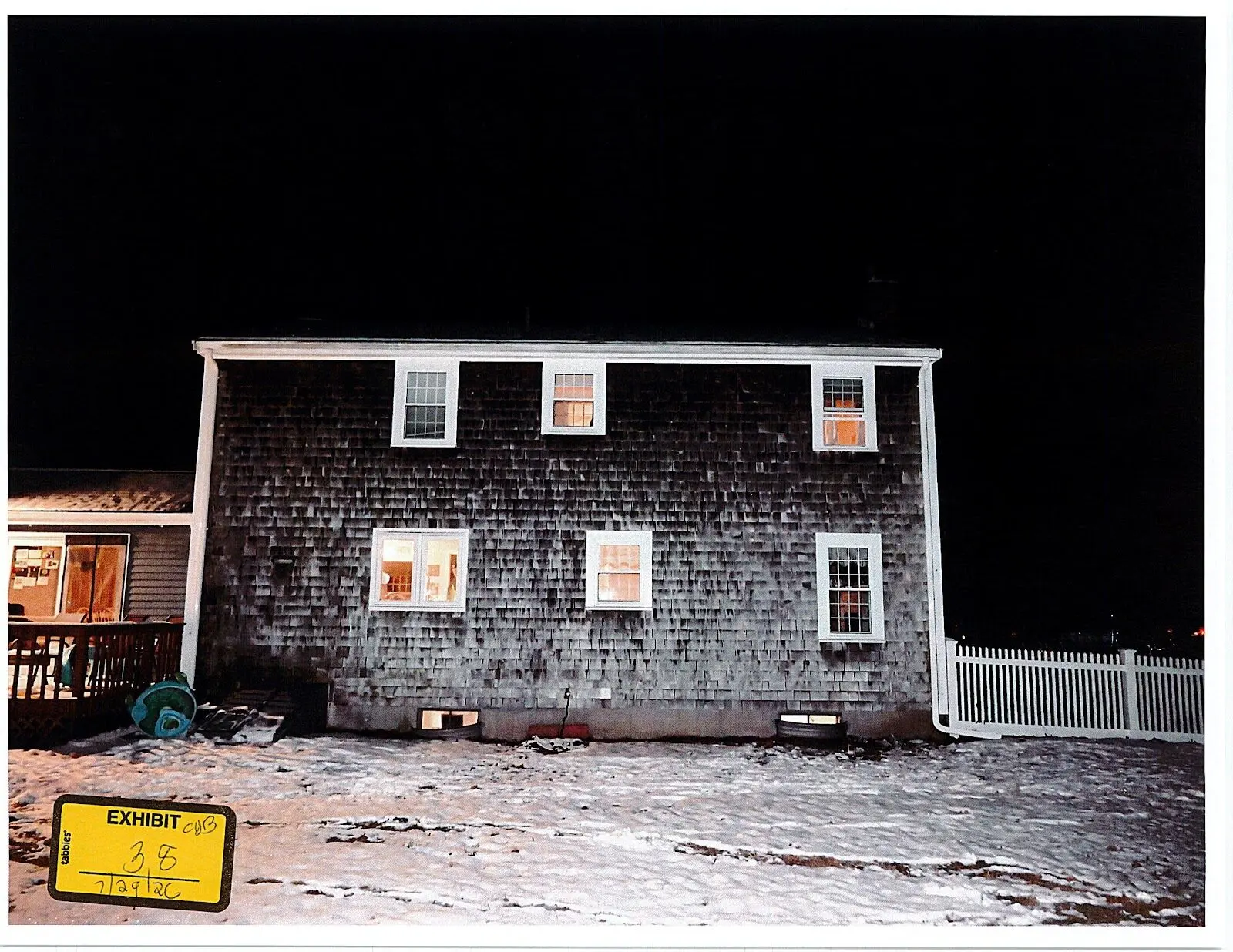
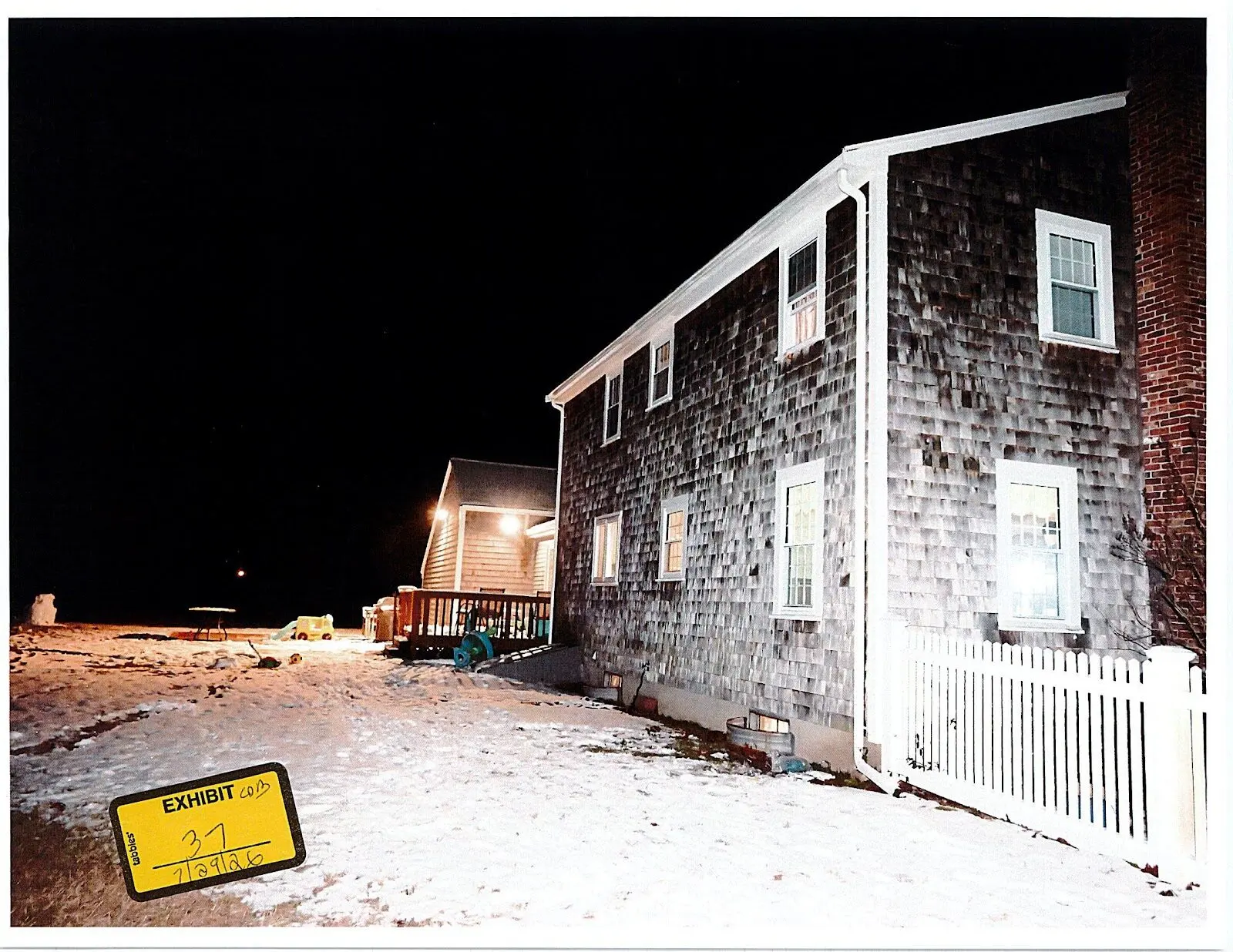
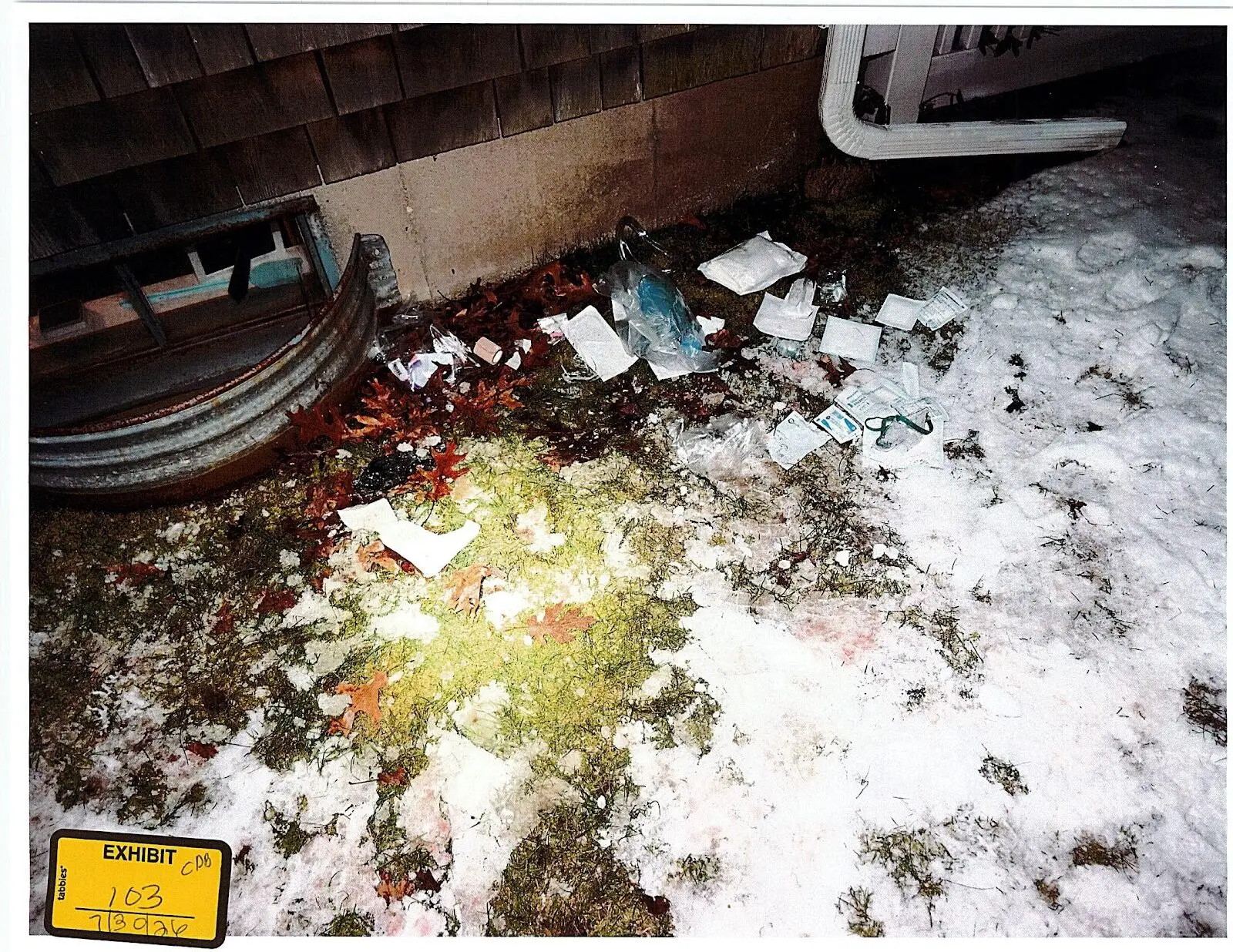
The photographs fix two locations. Exhibits 37 and 38 show a turquoise wound hose reel beside the deck; responder testimony places Lindsay's treatment area by the far-right window well. A later close view shows the ground only after treatment and removal.910
View post-treatment Exhibit 103 contains blood and medical debris
The testimony does not establish how wet her clothes were. Dr Elizabeth Laposata referred to wet clothing when explaining faster cooling, but did not identify the source of that observation. Located first responders described jeans, a tank top and socks without calling them dry, damp or soaked. Their silence does not show the clothes were dry; it leaves the moisture state unresolved.12
Can the bare patch measure heat or water?No—not without missing scene measurements
Water at 8°C is cold relative to skin and warm relative to snow. A stream could cool a body while melting or moving snow. But the post-treatment bare patch measures nothing: without scale, capture order, snow properties and a measured water source, pixels cannot be converted into litres or joules. The image cannot separate thaw and drainage from body contact, blood, treatment fluid, trampling or directed water.
Separate question: were the clothes rinsed?Inspect the photographs, limits and a testable protocol
Detective Maffeo of Duxbury police said he saw no blood on the displayed item or top and did not recall any on the jeans; counsel then proposed that blood had seeped through to the bra, and he agreed. On Day 12 the prosecutor put “some” and “a little bit” of staining to Sergeant Daniel Lawler of the state police, who agreed, and defence counsel put to him that in his experience it was blood, and he agreed to that too. The public testimony reviewed here names no garment-level confirmatory blood or DNA result.13
The full public frames show diffuse mottled discolouration without an obvious concentrated outer-garment deposit. That is not proof of absence. The fabrics are dark, the wounds were uneven, the garments were cut and handled during care, and their drying history is missing. A photograph cannot establish blood, clot, crust or rinsing by sight.
Water-altered blood is plausible: dilution or washing can spread or blur a deposit while latent traces persist. General mottling is not a diagnostic rinse pattern or a validated garden-hose signature. A Day 6 crime-scene supervisor from the state police laboratory, Sherri Crook, said red-brown staining cannot be called blood without a confirmatory test. A Lindsay DNA profile on her own clothes would also be expected; even a profile mapped to a blood-positive area would not by itself prove rinsing, deposition mechanism or actor.
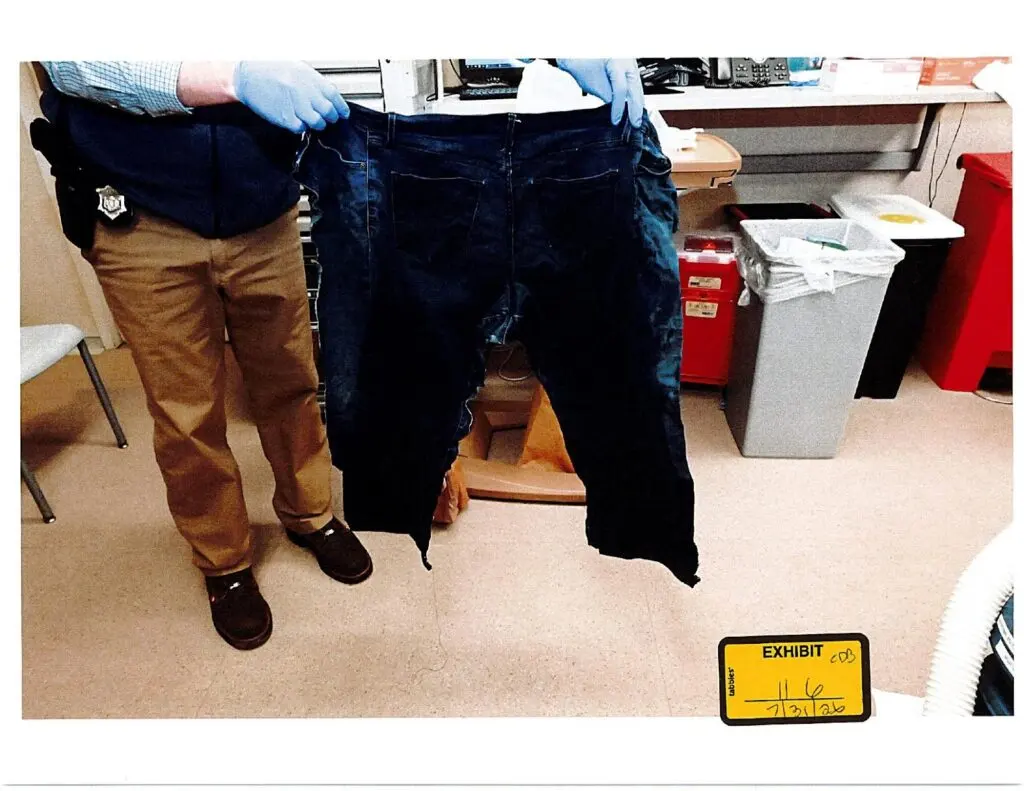
Exhibit 116 · jeans. Broad, uneven pale-blue mottling is visible. The photograph does not identify its material cause.
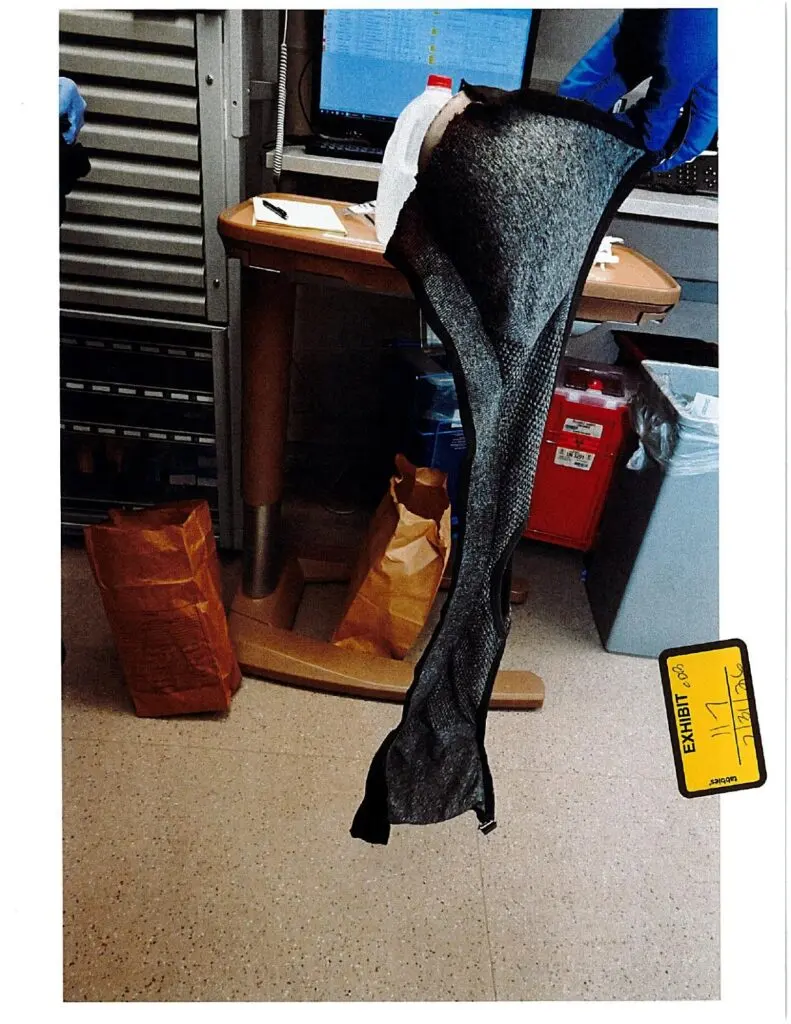
Exhibit 117 · bra. Patterned fabric, cutting and uneven tone complicate visual comparison.
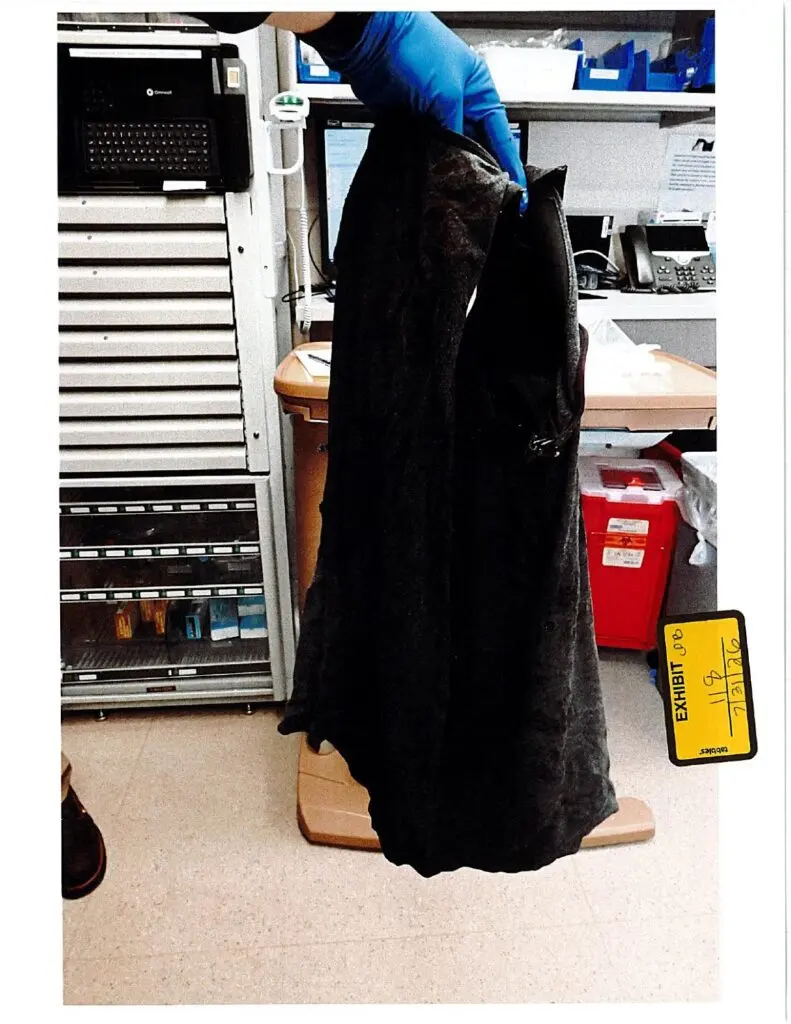
Exhibit 118 · tank front. Irregular grey-brown discolouration is plainly visible.
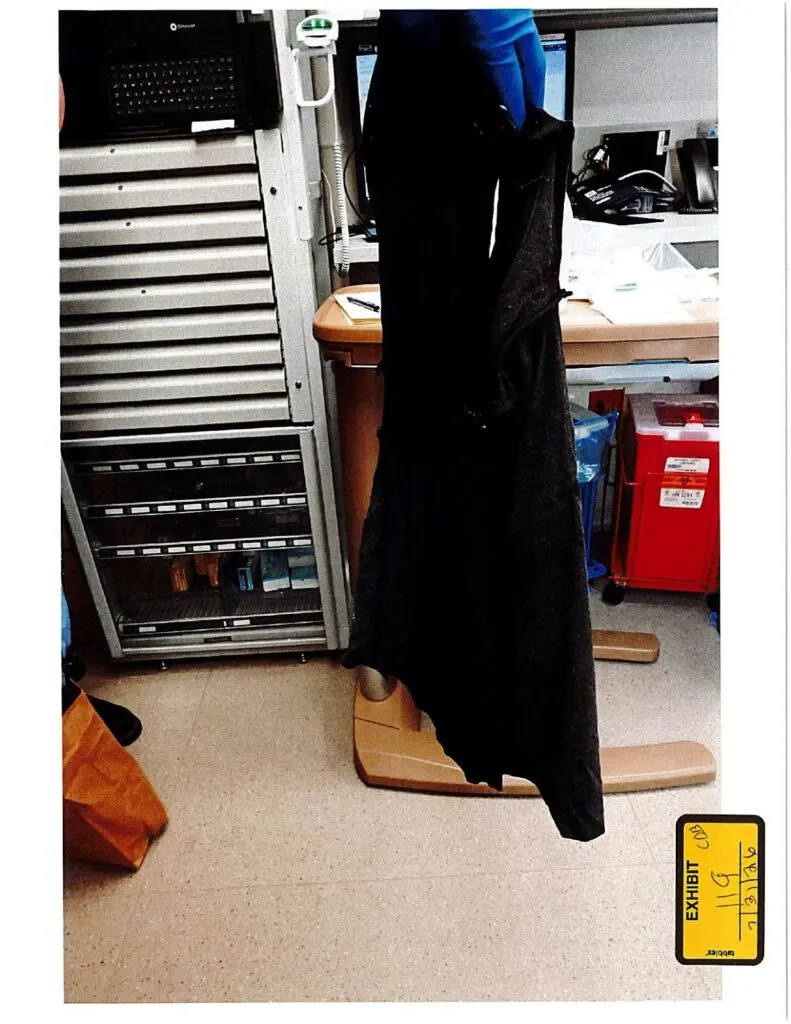
Exhibit 119 · second view. Uneven tone persists from another face or orientation.
A useful test would predeclare the expected difference between exposed and protected areas, photograph both faces, seams, folds and overlaps, map presumptive reactions, confirm human blood independently and tie any DNA result to the same mapped sample. Matched clothing should then undergo blood-then-water, snow contact, EMS cutting and handling. Rinsing loses support if the discolouration is not blood, the predicted spatial difference does not appear, or competing sequences reproduce the result as well.
Audit the spinal mechanism and medical evidenceAnimated heat circuit, chronic-SCI comparisons and equations
Spinal-injury stress test
How much cooling does the spinal injury buy?
Keep the same 81-minute clock. Change only the two thermal defences.It could matter. A high spinal-cord injury can leave the body less able to turn its radiator down—constrict skin blood vessels—or its furnace on—shiver. It does not add a third heat-loss pathway. Laposata described the first; the second comes from the spinal-injury literature, not the testimony. She supplied no watts, multiplier or patient cooling curve.
Trial descriptionT5–T6 cord injury; vessels dilate below it
→
Possible effectless constriction (testimony) and less shivering (literature)
→
Not measured hereneurological level, completeness, skin flow or shivering watts
Already granted in every displayed 81-minute run
0 W shivering
plus weaker flow control in a 55% lower-region proxy
Zero is the lowest possible shivering setting, and it is more than the injury buys: shivering is preserved above a lesion, and a T5–T6 lesion leaves the arms, shoulders, chest and neck able to shiver. The model gives that away rather than argue about it. The 45/55 body split and the 0.5/6.3L/h/m² blood-flow settings are declared stress-test choices, not measurements or an anatomical map of a T5–T6 lesion.
Average heat circuit during the saturated 52-minute ground phase
| Blood-flow test | Core to shell | Air + radiation | Snow + ground | Evaporation | Net body loss | Final core after 81 min |
|---|---|---|---|---|---|---|
| Both low-flow, 0.5 / 0.5 | 142W | 176W | 103W | 64W | 283W | 93.0°F |
| Declared regional proxy, 0.5 / 6.3 | 186W | 185W | 109W | 67W | 300W | 91.1°F |
| ASHRAE/Pierce ceiling, 90 / 90 | 423W | 249W | 145W | 99W | 432W | 83.9°F |
| Zero internal resistance, K→∞ | 429W constraint transfer | 262W | 153W | 107W | 462W | 83.3°F; 82.23°F low |
Both regions low-flow 0.5 / 0.5
93.0–94.1°F
Declared regional proxy 0.5 / 6.3
91.1–92.5°F
Both regions higher-flow 6.3 / 6.3
89.0–90.8°F
Source-model ceiling 90 / 90
83.9–87.0°F
Zero internal resistance K → ∞; not physiology
83.3–86.7°F
The finite source-model settings stay warm; deleting the internal bottleneck gets close. The declared regional proxy makes the endpoint 1.6–2.0°F colder than the both-low-flow comparison. At the Pierce/ASHRAE model's 90-unit input ceiling across the whole model body, the saturated run bottoms at 83.3°F and finishes at 83.9°F. A second, deliberately impossible test forces core and shell to one temperature with zero internal resistance. It bottoms at 82.23°F—only 0.13°F above the 82.1°F target—and finishes at 83.3°F after rescue warming. That is not a robust exclusion. Nor is the 90-unit ceiling the only route close to the reading: at the low end of the published tissue-property span (2.443kJ/kg/K), a 30 per cent shell share and 15L/h/m² in both regions—each declared separately on this page—the same saturated 81-minute run ends at 83.9°F. The gap survives a stack of cooling-favourable choices; it does not survive every combination the declared envelope allows, and the article says so rather than leaving it to be found.
Already the lowest possible setting.
In the saturated run, the endpoint rises from 91.1°F to 93.7°F. The 100W is arithmetic, not a patient estimate.
Seven men with tetraplegia cooled about 0.66°C/h on average; seven controls had no core decline. Rectal measurement.
One active skier's sublingual reading, which falls in cold air independently of the core. Uncontrolled and not a central-temperature calibration.
Plain English: human evidence supports failed vasoconstriction and faster core decline in some chronic high-SCI cold exposures. It does not establish acute whole-body watts or a universal “spinal-shock multiplier.”
Show the exact translation into the modelConductance, shivering and terminology
Skin blood flow changes core-to-shell conductance through K = area × (5.28 + 1.163 × flow). Across the model body, the four finite-flow rows correspond to 9.86, 16.10, 21.20 and 184.93W/K. The displayed differences are core endpoints, not the same number of degrees of extra whole-body heat loss: in the saturated run, the declared regional proxy is 1.96°F colder at the core than the both-low-flow comparison, but 0.73°F colder as a heat-capacity-weighted mean and has lost about 75kJ more to the environment. The rest is faster redistribution between core and shell. The flow setting stays fixed through every phase, so it cannot mimic changing haemorrhage, shock, fluids, vasopressors or treatment.
The zero-resistance branch is solved separately, not by typing an enormous flow into the finite-step model. Before its clock starts, the declared 98.0°F core and cooler shells are mixed to one heat-capacity-weighted 96.66°F temperature with no change in stored energy. The solver then holds all three nodes at one temperature and advances (Ccore + Cupper + Clower) × dT/dt = net external power. This produces the mathematical K→∞ boundary while preserving each external pathway and the moisture ledger. The immediate 1.34°F core change is redistribution, not cooling. If every node instead starts at 98.0°F, adding initial stored heat, the saturated branch bottoms at 83.22°F and finishes at 84.24°F. That sensitivity is why starting shell temperature remains an exposed assumption.
“Spinal shock” is the evolving depression of spinal reflexes; “neurogenic shock” is a circulatory syndrome from autonomic disruption. Neither word is a heat-transfer coefficient. A single 57bpm watch sample cannot diagnose that circulatory syndrome: 57 beats a minute is an ordinary resting rate, the published criteria pair bradycardia with hypotension, on the courtroom fall account the sample predates the cord injury, and the public record does not establish wearer, posture, paired blood pressure or exclusion of low-volume shock.
What does GCS 10 tell us?Marked impairment, not a cooling clock
A reported Glasgow Coma Scale score of 10 supports markedly depressed consciousness. It does not time the cooling or distinguish hypothermia from drugs, shock, trauma or brain injury. The public record lacks the component scores and exact assessment times.
How the model was checked—and where it stopsCode verification is not patient validation
The model divides the body into a core and two outer regions, then tracks metabolism, breathing, air and radiation, snow contact, retained moisture, evaporation and flowing water separately. Water transfer cannot exceed either the surface-contact limit or the heat the captured flow can carry away.14
Every published run uses one-second steps. Halving the step changed the endpoint by less than 0.01°C, and the energy ledger closes within its declared tolerance. Those checks test code and arithmetic, not patient assumptions. One declared choice runs the other way: metabolism is held at 70W for the whole run, although heat production falls as the body cools, and letting it fall would return roughly 0.05MJ to the ledger against a 0.59MJ shortfall. The human benchmarks stop around mild hypothermia; outputs below 35°C are extrapolations and below 32°C are stronger extrapolations.151617
The code can check
- units and conversions
- energy in versus energy out
- whether named inputs reproduce 82.1°F
- how the answer changes when one input moves
The code cannot establish
- the true starting temperature or exit time
- how wet the clothing was
- whether flowing water was used
- which history occurred or who caused it
The controls name physical inputs, not causes. “Pre-exposure state” does not assert drugging; “renewed water” does not assert hose use; “reduced defence” does not diagnose shock. Every slider is an assumption because the case has not fixed it.18
No case measurement fixes how much heat capacity belongs to these simplified shell nodes. The lab therefore shows fixed 10, 20 and 30 per cent shell shares as engineering stress tests, not a physiological confidence interval. Changing that share while holding starting node temperatures fixed also changes the implied initial whole-body heat content.
The spinal-injury section above shows the current 81-minute regional-flow and shivering sensitivities. Wet presets begin after wetting. Warming their 1.232kg retained-water inventory from 0°C to 20°C would absorb about 0.103MJ against the 1.63MJ whole-body-equivalent scale check.
Audit the model yourselfChange every assumption, inspect every watt and download the complete research pack
What an accurate reading would cost
The same is true of every route, and here the record does the narrowing. More time means an afternoon exit: the baseline runs need 134 to 167 minutes of ground contact before the latest working 6:30pm board time, putting her outside between about 3:45 and 4:15pm. Retail video independently places Patrick that afternoon; nothing independently places Lindsay indoors and alive. The devices record activity without establishing who held them, and Patrick supplies her voice on the 5:34 call, the search and the discovery—so the long clock exists only if his account does not. Continuous water reaches the target in seventeen to forty-three minutes, which fits the window; the reel is not at the reported treatment area, though the photographs do not fix where she first lay and the injury is never graded. A colder start needs her near 84–86°F by the time she goes out, though on any such cooling she was warmer earlier, so it does not by itself put her beyond acting. A fourth exit would belong to the model rather than the afternoon, and heat production is not where it lives; that was closed above. What is left is the coupling and tissue-property assumptions, which on published values reach 83.9°F, and the model's own admission that below 35°C it extrapolates. These are the histories this model prices, not the set of physical ones, and none of them names a person.
Which is why the measurement matters more than the model. Each exit is expensive: the chronology, the scene record, or the model's credibility below 35°C. If the reading is simply not what it appears to be, none of them has to be paid—and that is the possibility an expert was best placed to test and did not. Nothing in the located testimony chose between them.
Different histories
One reported endpointMore timeColder startContinuous waterSeveral changes together
82.1°Fcannot identify its own path
Forensic science needs a way to be wrong
That is not the model failing; it is the model doing what a forensic claim should do. A mechanism becomes useful in court when it makes a prediction that can fail. “Wet clothing increases cooling” is a mechanism; a stated moisture condition, weather and interval producing a stated temperature range is a test. Without that second step, a number goes in and an explanation comes out with nothing in between exposed to disproof. The National Academy of Sciences, the presidential science advisers and the standards institute have made the same demand: expose validity, reliability and empirical failure.
The temperature is not the only place the case does this. A bedside tumbler became crushed medication after Patrick reported powder in it; the residue was never tested. Staining became blood when counsel put the word to a witness who agreed from experience, with no confirmatory result. A phone record that cannot identify who held it became Lindsay going upstairs because the prosecution said so. In each, something testable was explained instead, and the explanation travelled.
The handover from ward to courtroom does the same at a smaller scale: the number keeps medicine's authority while losing the context that made it interpretable. Massachusetts evidence law lets an expert state an opinion before disclosing the facts under it, leaving cross-examination to draw them out. That safeguard works only on a premise someone exposes. When an expert inherits a clinical premise and explains it without exposing its time, site or measurement method, the jury can hear more certainty than the underlying record contains.19
Separate example: when an expert inherits a premisePatrick's report, the bedside glass and the missing chemistry
Patrick reported powder in a bedside wine tumbler. On that report, an expert went back to the photographs, saw powder-like material, and described the medication as “actually crushed”. The photograph is independent; the identification of its contents still traces back to Patrick's report. Toxicology proves drug exposure, not what was in that cup, when it was taken or by whom.20
Repeating one person's premise through a photograph, report and expert does not create three independent observations. Cup chemistry, reconciled pill counts, gastric findings and specimen-level draw times could strengthen or weaken the chain. Repetition cannot.
The records that could decide it
That underlying record is not a mystery. Much of it already exists; it has not reached the public record. The missing evidence is concrete:
- Temperature: the South Shore chart (Exhibit 138 by exhibit sequence), with the time, site and device for each reading, repeats and timestamped GCS components.
- Rescue: the Duxbury and Pembroke crews' electronic patient-care reports (ePCRs), dispatch and GPS logs, loading time and serial temperatures.
- Wetness and scene: contemporaneous garment notes, native front-and-back photographs, drying and laboratory records, mapped blood testing, the warming and fluid sequence, native scene images and any hose inspection or water-use record.
- Drugs and cup: cup custody and chemistry, pill counts, gastric findings, medication administration, serial concentrations, tube labels, draw times and accession mapping.
Until those records are produced the thermal history stays unresolved but constrained. The useful discipline is to write down now what each account predicts those records will show. A prediction made after the result is not a test.
The model cannot identify which history occurred, still less who caused it. The chart, the ambulance reports, the garment tests and the scene records could narrow the first question. The second was never one a temperature could answer.