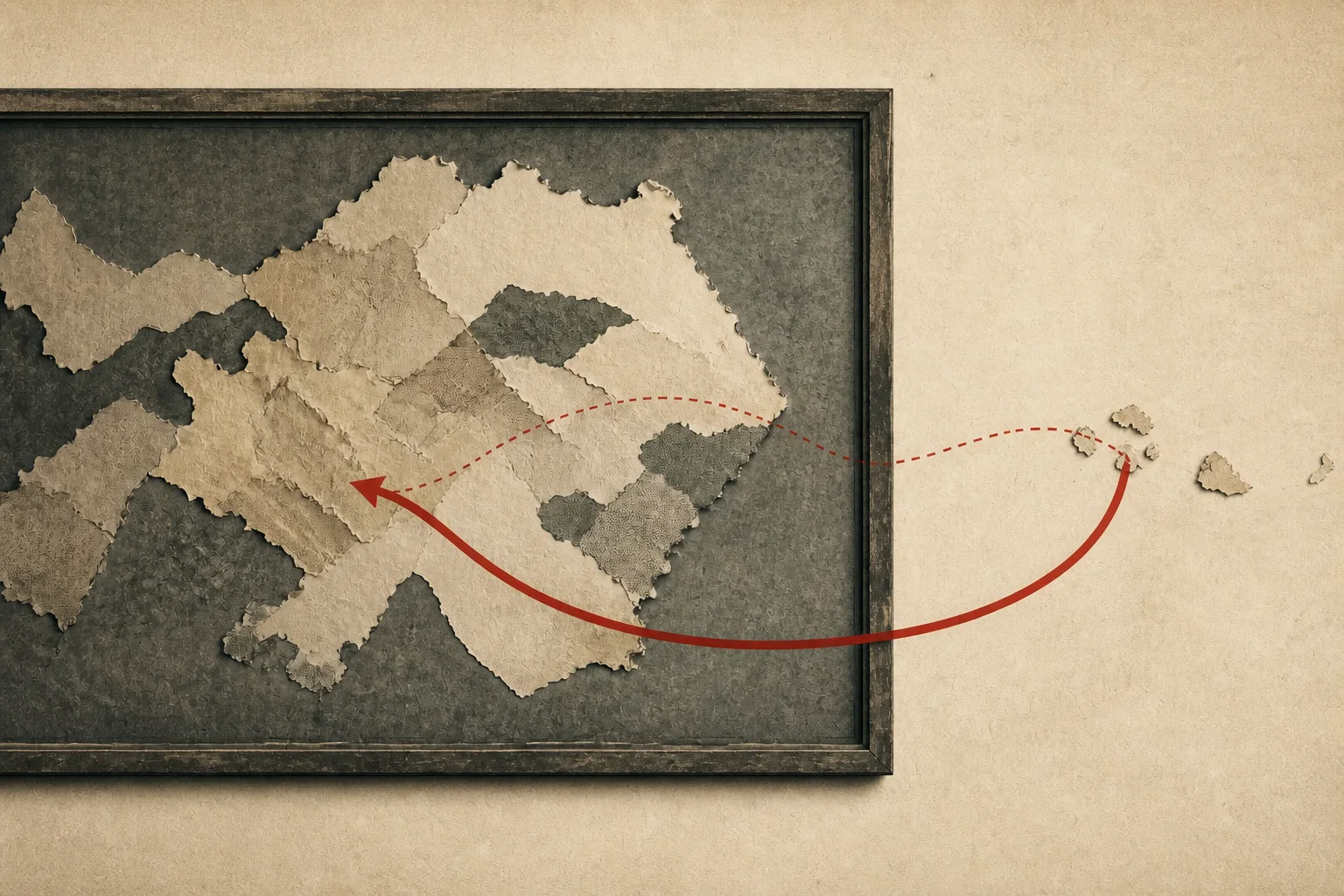
In the first draft of the speech Franklin Roosevelt gave after Pearl Harbor, the Japanese had “commenced bombing in Hawaii and the Philippines”. The president worked the paper over in pencil all day, and the Philippines fell out of the sentence: the attack became a “bombing in Oahu”. On the morning of the speech one more edit made it “the American island of Oahu”. The Philippines — 16m US nationals, attacked nine hours after Hawaii and overrun within months — was demoted to a list, mingled with British colonies, no hint which was which.1
The pencil marks are the opening exhibit of Daniel Immerwahr's How to Hide an Empire (2019), a history of the United States that includes all of it. In 1940 nearly 19m people lived in American territory outside the states, one inhabitant in eight: by population, the fifth-largest empire on earth. Roosevelt was not lying about the map; he was choosing it. Immerwahr can only guess at the motive, and says so; the polls were plain, and Hawaii was nearer and whiter. The “logo map”, he calls it: the familiar outline, minus the empire. It is the accounting boundary.2
A joke circulates online: fascism is when you do imperialism to white people. The thought is old: a Martinican poet wrote in 1950 that Europe could not forgive Hitler for applying to it the “colonialist procedures” reserved for its colonies, and Hannah Arendt named the return trip: the boomerang. But a pedigree is not a mechanism.3 Treat it as political economy rather than moral philosophy and most of it follows. In 2026, with the map's missing places back in the detention business, it is worth deriving.
Deriving it takes three observations, none about wickedness: order has a local price; technique, once built, keeps; and a category is the cheapest thing a state can change. What the colonies supplied was a stock: technique, kit, personnel and law, tested on people who could not answer back, and priced accordingly.
The price of order
Order, in this reading, is a purchase. Governments buy compliance with a blend of consent and coercion, set by what each costs locally. Where subjects vote, sue, strike and publish, coercion is expensive: every beating acquires a lawyer and a newspaper. Where they cannot, coercion is cheap. A polity spanning both price zones will run two regimes at once: liberal where violence is dear, extractive where it is cheap. Call it hypocrisy if you like; the mechanism underneath is procurement. Charles Tilly described states as “quintessential protection rackets with the advantage of legitimacy”. The nearest formal cousin is selectorate theory: rulers survive by paying the coalition they need, and in a colony the coalition that needs paying is a garrison and a governor.4
The empires produced something like an experiment. Where Europeans settled in numbers, Daron Acemoglu, Simon Johnson and James Robinson found, empires built courts, property rights and assemblies, the institutions of people who would use them. Where settlement was sparse, often because tropical disease made it deadly, the same empires built extractive states, made for “transferring resources rapidly to the metropole”. Same crowns, same decades; the institutions tracked where Europeans settled, then outlived their builders by centuries.5
Nor did the public at home ever see a balance-sheet. Two economic historians, Lance Davis and Robert Huttenback, totted up the British empire's books. By their reckoning, imperial investments often paid no better than alternatives while taxpayers bore much of the defence bill. Empire shifted income from the tax-paying middle class to the elites who owned its enterprises. The gains were private, the bill public, and the people paying never saw the books.6
Made abroad
An unaudited machine still produces, and what the colonial branch produced best was technique. Take the camp. Spain's General Weyler herded more than 300,000 Cubans into “reconcentration” camps from 1896; at least three in ten died. Britain built its own in South Africa four years later: 27,927 Boers — most of them children — died in them, with at least 14,154 black Africans counted less carefully. In German South-West Africa an extermination order and the camps that followed killed perhaps 80% of the Herero, events Germany recognised as genocide in 2021. Whether the Nazis' camps descend from these is disputed; that they came second is not.7
Race law travelled by seminar. On June 5th 1934 the Reich justice ministry convened the lawyers who would draft the Nuremberg Laws, and a stenographer kept the transcript. The meeting opened with a memo on American race law and returned to American models throughout. The legal historian James Whitman, who reconstructed it, found the most radical Nazis in the room were the keenest borrowers; America's one-drop rule struck even Nazi commentators as too harsh. Hitler named America, in Mein Kampf, the “one state” making progress toward the racial citizenship he wanted, and in a 1928 speech praised settlers who “gunned down the millions of Redskins to a few hundred thousand”. (The dinner-table lines about a German Mississippi are contested; the book and speeches are provenance enough.)8
Often the return leg was a person. Ralph Van Deman ran the army's first field-intelligence unit policing the occupied Philippines, came home to found the Military Intelligence Division in 1917, and retired into a private archive of 250,000 files on “subversives”. August Vollmer, the father of modern American policing, soldiered in the Philippines first; the sociologist Julian Go traces early police militarisation to this “imperial feedback”.9 The flow is measurable today: military kit reaches police through the Pentagon's 1033 Program, and its claimed crime reductions dissolved on replication. A 2018 study found no detectable crime or officer-safety benefit from acquiring or deploying SWAT teams, while Maryland deployments fell disproportionately on black neighbourhoods; cell-site simulators built for war arrive with FBI non-disclosure agreements; a Predator drone watched Minneapolis in 2020.10 None of it stayed on the periphery.
Moving the line
What kept the two regimes apart was a line. Empire's wall is a classification, citizen and subject, white and not: the cheapest of the state's works to change. America's Supreme Court rewrote the white line's rationale twice in three months. In 1922 a Japanese petitioner was not white, because “white” meant Caucasian. Three months on, an Indian petitioner — conceded to be Caucasian — was not white either, because the word followed “the understanding of the common man”. The line held; only the reasoning moved. Coercive apparatus is expensive and slow to build; a line is redrawn in a sentence, though at home the sentence can be appealed.11
A crisis makes the arbitrage available, not automatic: interwar Britain sat on the biggest stock on earth and left the line alone. A state that takes it commissions nothing new; it shifts the line inward and points what it owns at people who were inside. The Nazis took the move at continental scale. Their eastern war was conceived as colonisation: eastern Europe was the Germans' “Manifest Destiny”, as the US Holocaust Memorial Museum puts it. The planners budgeted for “many tens of millions” of superfluous people, Slavs and Jews having been reclassified onto the wrong side of the line before the machinery reached them.12 The joke's “white people” were people the line had been moved past.
Here the derivation stops. A stock of technique explains supply. Fascism also needed demand: a lost war, a broken currency, a mass movement of the humiliated. None of that came from the colonies. Robert Gerwarth and Stephan Malinowski put it sharply: Britain, France, Belgium and the Netherlands ran violent colonial empires, Britain's and France's far larger than Germany's, and produced no Reich. For them it was the Great War, not the colonial wars, that brutalised the generation that marched. Robert Paxton's definition of fascism — obsessive communal victimhood, cults of unity and purity, a mass party of committed nationalist militants — describes an engine no colony shipped home.13 The joke is bad taxonomy, decent genealogy and an exact description of the accounting.
How far the joke holds
- Built where coercion is cheap Camps, race law and surveillance were built and tested where subjects could not vote, sue or publish.
- Capital and personnel come home The transfer home is traceable in transcripts, service records and procurement files.
- The line moves inward Under stress, redrawing the category line is cheaper than standing the apparatus down.
- The leap the evidence cannot close The full equation needs a demand side — defeat, depression, a mass movement — the colonies never shipped.
The ledger
The accounting is the part history checked least. At Nuremberg the audit was drawn narrowly: crimes against humanity counted only “in execution of or in connection with” the war. The tribunal ruled that Germany's pre-war persecutions — “revolting and horrible as many of these crimes were” — fell outside its writ. And the nexus kept more than pre-war Germany out: colonial conduct was never in the room.14 The Genocide Convention was trimmed in the same direction. Cultural genocide was voted out, 25 to 16; Canada, France, Britain and America were among the noes. The American delegation traded political groups away for ratifications. The United States, having helped write the definition, declined to ratify for 40 years, then insisted no dispute involving it reach the world court without its consent.15
Two write-offs show the method. In 1943 Bengal starved — reconstructions put the dead between 1.5m and 3m — after Britain's denial policy stripped the coast of rice and boats and the War Cabinet declined to divert shipping. Leo Amery's diary records Churchill weighing underfed Bengalis below “sturdy Greeks”. A 2019 soil-moisture reconstruction found it the one major Indian famine on record with no drought under it. Bengal is filed under weather.16
California is filed under destiny. Between 1846 and 1873 its native population fell from perhaps 150,000 to 30,000; the historian Benjamin Madley counts 9,492 to 16,094 killed by vigilantes, militiamen and soldiers, financed by more than $1.7m in state and federal money. Disease, hunger and dispossession took most of the rest. A “war of extermination”, the state's first governor told its legislature, would continue “until the Indian race becomes extinct”, a result he filed under “the inevitable destiny of the race”.17
The differences are real: an industrial extermination programme is not a prioritisation famine, and a frontier militia is not Treblinka. One school of historians holds both thoughts at once: the methods were continuous, the intent was not.18 But conceding the difference did not mean anyone examined the rest. Treating the Nazis as a one-off monster also suited the other powers: if the crime was unique, nothing else needed looking at, and for generations little else was. The categories were not discovered; they were negotiated, and governments with empires sat at the table.
The inventory
Now watch the same bookkeeping at work. Since February 2025 the administration has cycled more than 700 migrants through Guantánamo Bay — the first sent from inside the country, not intercepted at sea — at $60m for six months. In March 2025 the United States flew some 260 men to a Salvadoran prison it pays for; a year on the Salvadorans among them were still held incommunicado: enforced disappearance, says Human Rights Watch. Florida ran some 21,000 people through an Everglades camp, its governor says, and closed it within a year. In July 2025 Congress gave ICE $75bn through 2029 — against a budget of about $10bn a year — and in June 2026 added roughly $70bn more, $38bn of it ICE's.19 The money is new stock, laid in at home.
The troops are the return leg. Marines deployed to Los Angeles in June 2025; a federal judge found the operation violated the Posse Comitatus Act; the ruling was stayed on appeal. Guard units federalised for Chicago lasted until the Supreme Court declined, 6–3, to rescue an operation that had “failed to identify a source of authority”. In Washington, with no governor in the way, an appeals panel suggested the president holds a “unique power”. On July 14th 2026 the Pentagon confirmed the capital's Guard deployment will run to 2029: nearly 5,000 troops from more than 20 states, at more than $3m a day.
In Minneapolis in January 2026, federal agents shot dead two American citizens — a woman in her car, a nurse filming an arrest — while the governor readied the state's Guard in response. As of July 2026 the Insurrection Act stays uninvoked; the president brandishes it on social media instead.20
None of this needs a design; stock accumulates by procurement, not plot. Nor is any of it yet what the joke names: demand is the one thing nobody can buy. Supply is the half a country can watch, if its map shows it. The joke, taken seriously, is an audit instruction: the question is not whether a monster has arrived but where the line sits, who holds the stock, and whether anyone reads the books. Roosevelt's pencil moved no line; the courts had drawn that long before. It moved the ledger — 16m people off the page his country read. The pencil is already out.