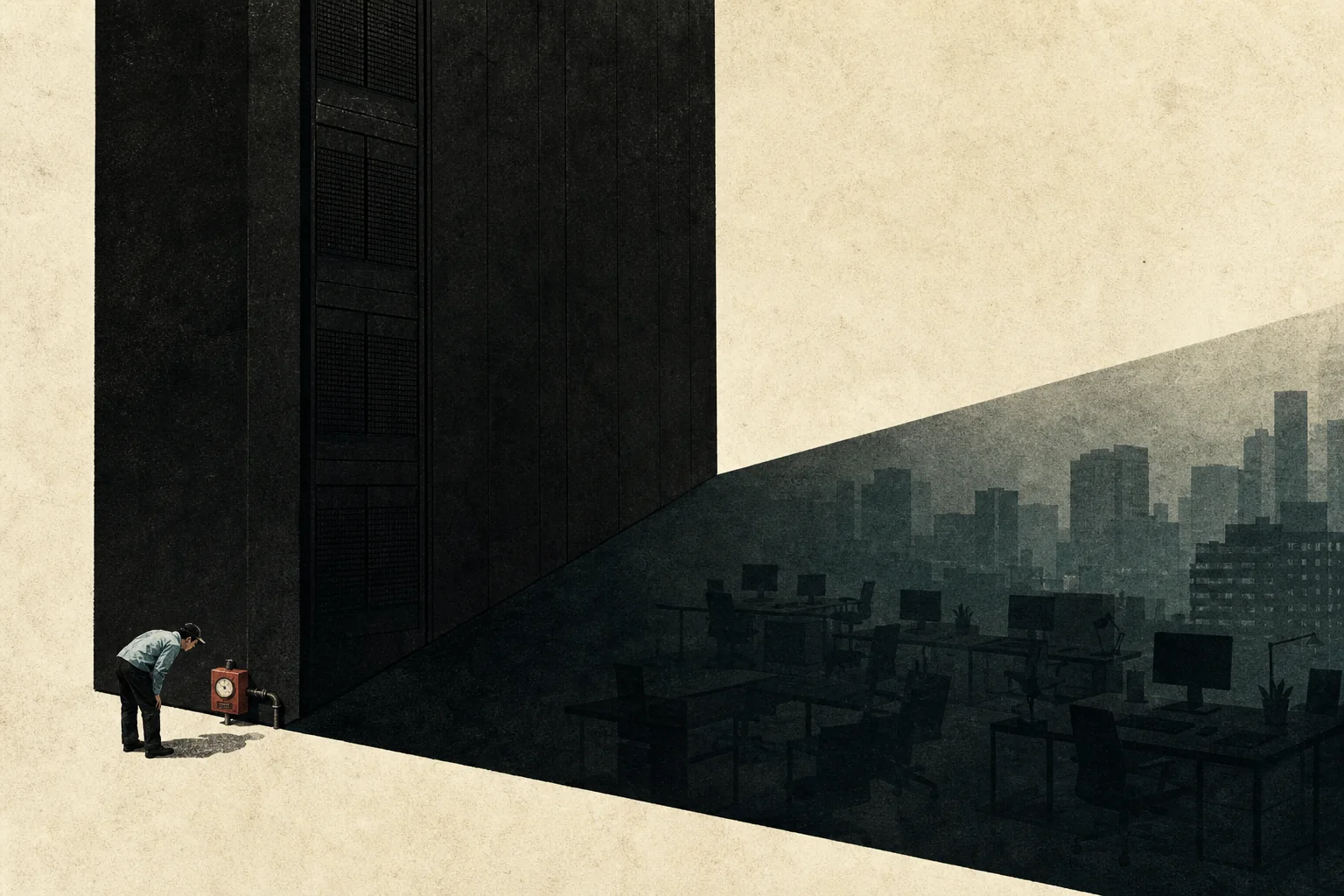
For more than a year the town of The Dalles, Oregon, fought in court — its legal costs paid by Google — to stop a newspaper finding out how much water the local data centre used. When the city gave up, the records showed a single building consuming more than a quarter of the town's water, and rising.1
Much of the worry about artificial intelligence in 2026 is physical: the power its data centres draw, the water they evaporate, the planet supposedly drained to run a chatbot. At planetary scale, some of that language does not survive arithmetic. Google measured the median text prompt to Gemini at about a quarter of a watt-hour, the energy of a second in a microwave oven. That is the cost of serving the prompt, not a life-cycle bill: training, storage and networking sit outside it. The world's data centres consume roughly 1.5% of its electricity, less than a fifth of what air-conditioning uses.2
But The Dalles is not a global average, and the costs that bite are not the ones in the global total. They are concentrated: on one small grid, in one town's water, in the roughly 5,000 megawatts Virginia's data centres were forecast to pull at peak. They fall at the margin, where the newest data centre's electricity is dirtier than the average and can keep a coal plant open. Efficiency is not cancelling growth. As each computation gets cheaper, more computing gets done; that rebound is one reason total demand can climb even as the cost of a calculation falls.3 Data centres can be a small share of the world's electricity and still see their demand double by 2030.
Even so, a data centre is not always the obvious place to start a water fight. In Utah, 63% of consumptive water use in 2016 went to irrigated agriculture and 13% to salt-pond mineral production; all urban and industrial uses together accounted for 11%. The Great Salt Lake has fallen about 11 feet since 1847, chiefly because of agricultural diversion, and alfalfa occupies nearly half the cropland in its three watersheds. A server farm is a more legible target than a water-right regime. That may explain some of its political prominence. It does not make The Dalles's quarter-share imaginary. The distinction is one of scale: a data centre can strain one town without chatbots draining the planet. The planetary claim's survival suggests it is doing a second job: it measures the harm badly and marks a side well.4
What actually binds
The binding physical limit is not the one people argue about. It is not the query, which is trivial. It is not thermodynamics: a chip runs about a million times hotter than the floor physics sets for erasing a bit of information, leaving scope for decades of efficiency gains. Nor is it land. What binds is duller: the stacks of high-bandwidth memory beside each processor, and the local grid. Fetching a number from that memory takes roughly 100 times as much energy as the calculation done with it, so the machines spend most of their power shifting data rather than computing. That memory is also the most carbon-intensive part of such a machine to make, and manufacturers have sold its advanced packaging years in advance.5
A rational way to lose money
Why, then, are four American hyperscalers planning roughly $700bn of capital spending in 2026, much of it on AI infrastructure, when the chips in those warehouses have economic lives of only a few years?6 The easy answer is "a bubble". But the spending has a rational core. A firm with a durable lead in machine intelligence could take a share of the work it replaces — part of a global wage bill of around $60trn a year,7 far more than is now being spent to chase it. Even at long odds, that can justify huge and risky bets. And most of the money is spent by landlords: the few firms that own the buildings and the chips earn rent whichever model-maker wins.
Rational for each firm is not the same as sensibly priced overall. Britain's railway mania of the 1840s was rational competition over a transformative technology, and its investors earned less than government bonds paid for a decade.8 What separates a land-grab from a mania is not the motive — both are rational — but the timing: whether demand arrives before the chips are written off. Railways, and the dark fibre laid in the late 1990s, could sit idle for 30 years and still be worth using cheaply later. A data centre's chips are written off within a handful of years, and firms increasingly buy them with debt at interest rates that are no longer near zero.
What the firms are buying
What the firms are buying is not merely the model. Models are becoming easier to reproduce and improve: DeepSeek's V3 matched several then-frontier benchmarks with an official training run it priced at $5.6m, though that figure excluded prior experiments and the cost of the hardware.9 Harder to commoditise is use, and the data it generates. Intelligence increasingly looks like something a system gains by acting in the world and getting feedback, not by absorbing a fixed store of text. The scraped internet is a record of other people's experience; the program that beat the world's best players at Go learned by playing, not by reading old games. If that is right, the advantage lies in access to a rich, live environment with real consequences — which may be found less in chatbot logs than in the physical economy, and in work itself.
There is a catch. Machines learn best where the environment gives cheap, clear feedback: a game with a winner, a proof a checker can verify, code that either runs or does not. Most of the economy offers no such signal. Whether the method works beyond these tidy cases is what the whole build-out is betting on.
Where the bill lands
However it ends, the losses are unlikely to come as a crash. The losers' chips will simply stop earning; the winners will pass on what costs they can. Not yet to ordinary bills: Virginia's legislative auditor found that data centres in the state pay their full share today. But the same report expects that to change. And in the wholesale market it already has: the monitor of America's largest grid blames data-centre demand for billions of dollars in higher capacity costs, which every household on the network helps pay.10 Political choices, not markets, will decide who ends up paying, and when. None of which makes ordinary people bystanders: pension funds hold the shares, the phones run the tools, and towns compete to host the warehouses for the tax revenue.
The surplus problem
The bigger risk may run the other way. The worry is scarcity — that the machines will use too much power and water. The older economic danger is the opposite. A machine that can do a growing share of human work is a machine for producing more than a society can easily use, and the harder problem in an economy has seldom been making enough of something. It has been absorbing what gets made.
Keynes expected his grandchildren to work 15-hour weeks by now. Productivity rose enormously; the leisure fell far short. David Graeber offered one disputed explanation: modern societies create jobs that even their holders experience as pointless, absorbing hours instead of freeing them.11 If so, that is one way to absorb a surplus, and it was not chosen for anyone's comfort: the way chosen first is usually the one that costs the powerful least.
Which one a society chooses is not set by the technology. It depends on what people want, and people want more than economic models assume: to be needed, to have a place, to keep busy, sometimes to have someone below them. A machine that can do the work sharpens that choice without making it. The same machine can be used to let more people think, or to let fewer people decide; it settles neither. The Dalles went to court for its number and got it: a quarter of the town's water, and rising. Locally, that number is the answer. What a society will do with a machine that can do its work is a different question, and no amount of counting settles it.