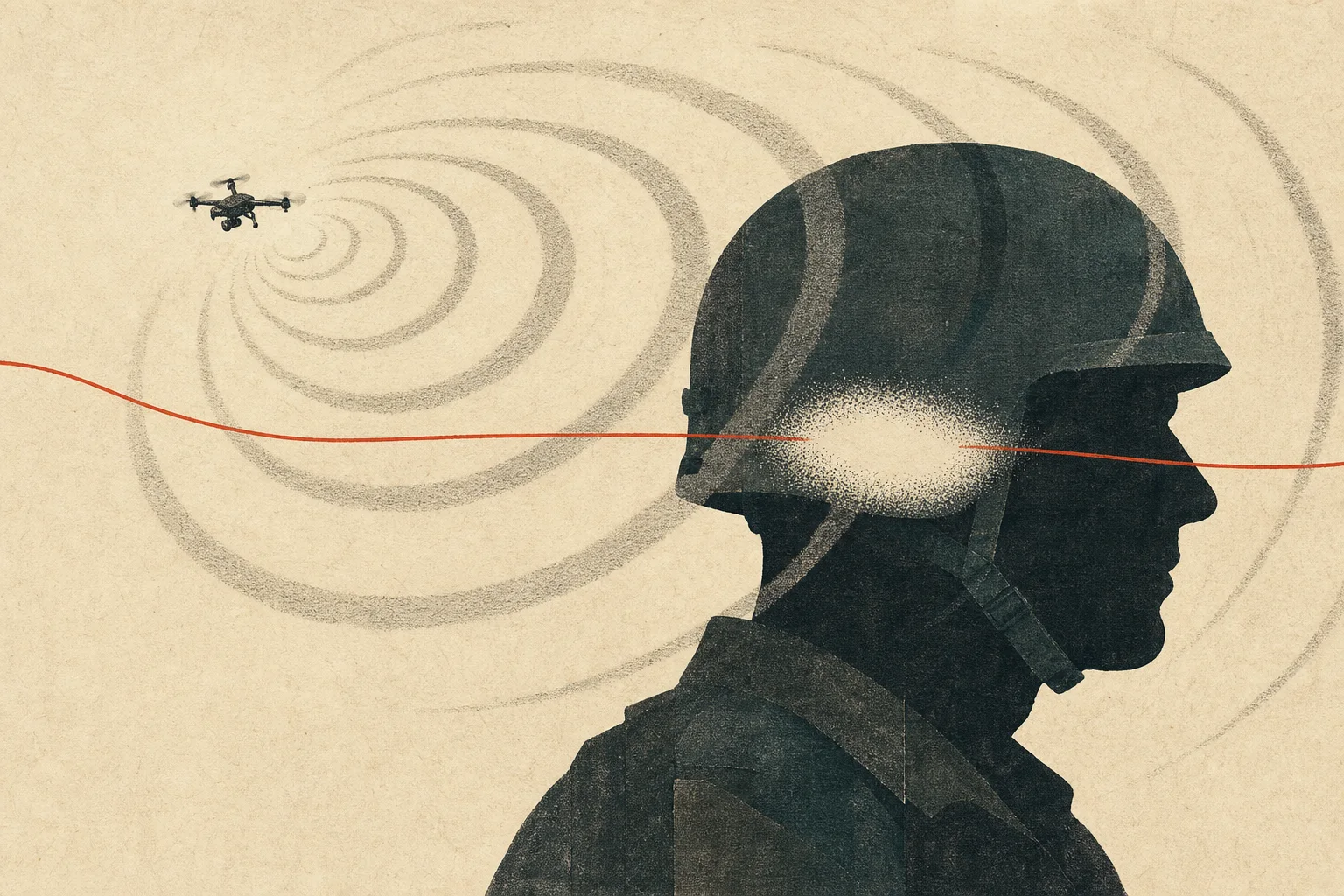
For roughly $500, an army can combine a camera, a battery and an airframe into a basic first-person-view drone. Add a warhead and its operator has a guided munition that can chase a moving person or vehicle. More range, payload or protection against jamming costs extra. Even so, the arithmetic is compelling. Ukraine's defence ministry says its drone units recorded more than 800,000 verified strikes against enemy targets in the first five and a half months of 2026. On its tally, that is more than three drone strikes a minute. Guided attack has entered the factory age.1
A front that was a line is now a belt. In May the United Nations verified at least 64 civilians killed and 539 injured by short-range drones, a category broader than FPVs. That was the highest monthly toll from such weapons since the full-scale invasion began. Ukraine's drone commander puts the belt exposed to regular, dense attack at 25km or more on either side of the front, depending on the sector. Fibre-optic FPVs help sustain it: pictures and commands run through a filament which ordinary radio jammers cannot drown out, though the cable can snag or break.
Movement through the belt has become a combat operation. A military doctor in Kharkiv told Reuters in February that evacuation took more than three days on average. In six months the UN verified 20 short-range-drone attacks on clearly marked humanitarian vehicles or facilities, most during evacuations.2
Those figures capture only the most visible damage. Abundance does two things at once. It makes people the scarce part — trained pilots and jam-resistant links are what run short, which is why armies reach for software. And it makes people the part that absorbs the blast, in a wound instruments struggle to see. Two records remain unusually hard to reconstruct: the machine's part in choosing a target and the blast dose received by a survivor. The dose seldom reaches a casualty card; the choice may have to be inferred from wreckage. The airframe is the part an army can put on an invoice.
The dose nobody logs
The blast behind those counts is older than the drone, and so is the incentive not to look at it. Charles Myers published the term “shell shock” in The Lancet in 1915, when it was still taken to be physical — a commotion of the brain. That same year the British Army in France ruled that such a casualty was marked W, for wounded, and earned a wound stripe and a possible pension, but only if his collapse was “due to the enemy”. Where no shell could be pinned to it, he was marked S, for sickness: no stripe, no pension. An administrative judgment about cause decided whether the casualty counted as wounded, and what pension rights followed.3 The lesser exposure comes from a weapon designed to throw its explosive away from the people firing it. The propellant that launches a mortar round sends a lower-level pulse of overpressure past the crew; a crew may experience it across hundreds of firings. In a small study of Ranger mortarmen, nearly 500 rounds fired over three days coincided with headaches, tinnitus, forgetfulness and slower thinking; the Pentagon now publishes exposure precautions for mortars.
A quadrotor carrying a warhead reverses the geometry: it takes the explosive to its target. For someone beside the detonation, exposure can be far greater. Fragments, violent acceleration and burns may join the pressure wave. The two doses are not equivalent. A survivor of a nearby detonation cannot be judged only by the wounds that show.4
At the target, the injury can arrive several ways at once. The pressure front acts directly on the body; fragments penetrate it; blast winds throw it; heat burns it. Any of these routes may involve the brain. A casualty record describes the wounds a medic sees; it seldom preserves the pressure dose.
The most revealing evidence may be the interval the survivor cannot remember. After a nearby blast, a person may be unconscious; awake but dazed or disoriented; or walking and talking without forming a continuous memory. The last state is post-traumatic amnesia. In mild TBI, standard clinical imaging will usually be normal. The gap is evidence that awareness, orientation or memory formation was interrupted — and the stretch of the record the patient cannot fill.5
Medicine can define a lapse of consciousness more confidently than it can explain one. Awareness appears to depend not merely on intact tissue but on activity spreading and combining across the brain. Across sleep, anaesthesia and severe brain injury, conscious states tend to produce evoked responses which are widespread and complex; unconscious states produce more local or repetitive ones. A structural scan shows anatomy. It is an imperfect proxy for function.
An April VA study found exactly that split. Among 107 combat veterans with no reported history of military or blast-related TBI, greater reported exposure severity went with slower oscillatory communication; more numerous and closer exposures went with differences in how resting networks were organised. Regional brain volume showed no relationship. The study cannot diagnose an individual or prove that blast caused the differences; what it unsettles is the authority of a clean scan.6
A real feedback mechanism can help organise neural timing and still leave no mark on a structural scan. Weak electric fields are one such route. Neural currents create extracellular fields which feed back on nearby cells. At physiological strength such fields have altered spike timing and synchronised neighbouring circuits without synaptic connections; slow activity has even crossed a complete gap in tissue. Imposed travelling fields have shifted timing across a macaque's cortex and altered attention and memory in people. This is a claim about mechanism, not a theory of consciousness: weak fields can organise activity from outside the synapse.7
Nobody has shown a blast selectively disrupting that mechanism. But if blast disturbed that feedback, current tools would struggle to prove it: EEG and MEG record the very currents which generate the fields, so a changed signal cannot neatly separate a damaged source, lost synchrony and weakened feedback.8
What the scan does not settle
- No volume association Regional brain volumes did not track reported lifetime blast exposure.
- Slower, different networks Severity tracked slowing; total and close-range counts tracked active regions and core subnetworks.
- One signal, several causes EEG and MEG cannot separate source damage, timing and field feedback.
- A decision nonetheless Agencies still have to judge return, care and benefits.
Institutions cannot wait for a complete theory of consciousness. Under standard rules, an injury may still count as mild after nearly half an hour of unconsciousness or almost a day of confusion or amnesia. Such thresholds help with triage and return to duty; they are rules for acting under uncertainty, not discoveries about mechanism. Beginning in 2023 reporting by Dave Philipps of the New York Times traced headaches, memory lapses and cognitive problems through artillery crews and mortar teams. It showed how poorly the services were connecting exposure, symptoms and pathology. In 2024 the Pentagon ordered exposure monitoring, cognitive baselines and medical follow-up across the services.9
For the VA, the harder problem is deciding on treatment and compensation, often years later. A blast can cause both TBI and PTSD, and the VA says even neuropsychological tests may not distinguish them. The Pentagon may have an exposure record, a cognitive baseline and a staged-return protocol; the VA may have to reconstruct the event from service files, witnesses and a memory containing a hole. PTSD is real and treatable. It is not the residual label for every failure a scanner cannot see. A normal image is not a safety clearance.10
The choice inside the machine
The other record has to be designed into the weapon. Once pilots and radio links become the bottleneck, designers turn to code. A fibre-optic cable preserves human control by replacing radio with thread. Onboard software can dispense with the link altogether. Both evade ordinary radio jamming; only the second can shift target choice from pilot to machine.
“Autonomous” covers several different things. A drone may follow a route, recognise an object or home in after a person chooses it. The decisive question is who chooses the specific target. With a lethal autonomous weapon, a person may set the area or target profile; software selects the object and decides when and where to strike.11
1 · Self-flight
Machine flies
Software navigates, stabilises or searches. A person still chooses the destination or target.
Specific target: human
2 · Human-authorised attack
Machine finishes
A person selects the target and orders force. Software tracks, homes and strikes.
Specific target: human
3 · Lethal autonomy
Machine chooses
A person sets the mission or target profile. Software selects the individual target and attacks.
Specific target: machine
Marketing obscures the distinction. On July 7th a Ukrainian company presented LITAVR as the world's first fully autonomous interceptor. It can take off, search for and shadow another drone by itself, but waits for a person to give the final command. Ukraine says a second interceptor passed combat tests in June and automates 95% of the engagement; there too an operator selects the target and orders the attack. Both fly autonomously, and in both a person still gives the order to strike.12
Battlefield evidence points farther. A Ukrainian drone executive says that, in a 2024 trial, ten quadcopters flew without a control link, searched an assigned area and attacked targets chosen by their own software. Reconnaissance later found two dead Russian soldiers and a damaged truck, he said. The account has not been independently verified. It nevertheless describes the thing the marketing claims do not: a machine choosing the individual target. Recovered Russian V2U drones are harder evidence: they carry processors and sensors but no communications gear, and appear able to navigate, search and select targets onboard. Ukraine's stated policy keeps people in final lethal decisions. Doctrine is not telemetry. And that is the difficulty: the trial rests on an executive's word, and a drone with no link home reports to nobody while it flies. What the machine picked is a thing outsiders infer from wreckage.13
That boundary matters because authority can pass to software but responsibility cannot. A system can classify a shape and release a weapon; it cannot understand surrender, exercise mercy or answer for a mistake. Those duties remain with designers, commanders and states. The machine needs neither consciousness nor free will to acquire causal power. The farther automation reaches into judgments about civilians and proportionality, the more the moral argument becomes a software specification.
The strategic change is what self-flight buys: one person can release many machines which need not call home, easing pilot shortages, removing the signal an enemy would jam and letting weapons wait. In May a Ukrainian company lifted a Hornet strike drone above 8km by weather balloon, then released it for a 42km glide. The trial tested range, not an aerial ambush. Add persistent sensing and autonomous target selection, however, and the contraption begins to resemble a mine in the sky.14
That reach is already real. On March 1st a single Iranian Shahed struck an operations centre at Port Shuaiba in Kuwait. It killed six American soldiers from a logistics command and wounded more than 30. Across Iran's wider missile-and-drone campaign, satellite analysis by the Washington Post found damage to 217 structures and 11 pieces of equipment at 15 American sites, including aircraft, fuel systems, radar and communications gear. Army Central says one general suffered a traumatic brain injury; some survivors say screening and treatment were slow. The wound medicine struggles to see had reached a logistics command far behind the line.15
The target is often not the fighter but the chain that makes it useful: the tanker, the radar, the runway, the satellite link and the people who run them. Each gathers people, fuel and communications in one place. So does an aircraft-carrier. No American carrier is known to have been hit in the Iran war, and a moving ship is harder to find than a parked aircraft. Autonomy can simplify the final attack and help overwhelm defences; it cannot solve the ocean-wide search. In June America's government auditor said recent conflicts were pushing the navy towards a mix of large platforms and smaller, more dispersed systems.16 Cheap attackers need not destroy the whole system to make concentration expensive.
The rules are moving more slowly. A weapon which can wait, search and choose pushes legal judgment backwards—from a pilot's last click to code, data and a target profile. America's directive requires testing, senior review and systems whose technologies and data sources are transparent and auditable to relevant personnel. It does not specify what a weapon must retain after a particular engagement. The UN secretary-general wants a binding agreement by year-end; states have yet to agree whether the result should bind them.17 The law will arrive long after the weapons.
Paying without the record
A severe TBI can generate lifetime costs in the high six figures or millions in an American health system. That is the catastrophic end, not the typical mild concussion. But by November 2025 the Pentagon had recorded 533,519 first-time TBI diagnoses since 2000, four-fifths of them mild. Brown University's Costs of War project expects medical care and disability benefits for veterans of the post-9/11 wars and their dependants to reach $2.2trn–2.5trn by 2050. These are system totals, not a bill for drone strikes. They show how wartime injuries become public liabilities that last for decades.18
America's compensation system is cumbersome but generous in the long tail: payments are monthly, tax-free and not means-tested. In 2025 the VA paid more than $195bn to 6.9m veterans and their families. When the evidence is evenly balanced, American law gives the claimant the benefit of the doubt. Claims can still drag, especially when TBI is complex. But uncertainty can mature into a continuing public obligation.
Russia puts more of the burden on the claimant and pays earlier. A severe wound brings ₽3m; disability can raise the one-off total to ₽4m, with pensions, housing help and rehabilitation handled separately: the system is not empty, but its chronic support sits elsewhere. Even concussion counts under the wound schedule only if it prevents service for at least seven days and a doctor records it within three. Enforcement is patchy: prosecutors took more than 2,800 measures over veterans' benefits in the first half of 2026, and independent reporters documented at least 319 badly wounded soldiers sent, or threatened, back to combat before rehabilitation.19
These are not like-for-like programmes, and the difference is not merely generosity. It is where the first line of risk falls when science cannot settle a claim. America turns uncertainty into a long public liability; Russia demands prompt proof and leaves the rest to separate programmes. A normal scan chooses neither rule; policy does.
Ukraine's register listed 1.42m combatants and 143,390 people disabled by war at the start of 2026, but the OECD says the country still lacks an integrated route from military care to civilian life. Its casualty and compensation systems count deaths, disabilities and claims, not population-wide brain injury caused by drones.20
An army can put the airframe on an invoice. The interval a survivor cannot remember never appears on one, and a machine cannot produce a target-selection record it was not built to keep. The burden of the first gap falls on the wounded; responsibility for the second remains with designers, commanders and states. The airframe was always the cheap part.